PushBundle vs Bundler looks like a simple comparison until you build a real bundle campaign with complex product variants. Bundler is a long-established Shopify bundle app with a generous free plan and a strong review base. PushBundle focuses more specifically on mix and match bundles, build-a-box offers, B2B packs, variant restrictions, and guided customer selection flows.
That difference matters more than most merchants expect. Kard’s ecommerce AOV research says that strategic product bundling results in a 55% lift in AOV and an 86% increase in revenue per user when executed with intent. Those numbers only hold when the bundle flow is built around how customers actually make decisions.
A bundle app that confuses customers at the variant selection step will quietly cost sales long before you realize what went wrong. Choosing the right app from the start protects that conversion path. And here we are with the right guide to help you choose the right app.
- PushBundle is better for flexible, shopper-built bundles.
- Bundler is better for simple fixed bundles and quantity deals.
- PushBundle handles mix and match, build-a-box, variants, and B2B packs well.
- Bundler offers a lower starting price and a larger review base.
- The right app depends on bundle complexity, customer choice, and cart behavior.
Tabla de contenido
Feature Comparison Table
| Feature | Paquete PushBundle | Empaquetador |
| Fixed bundles | Supported | Supported |
| Combina y mezcla paquetes | Strong fit | Supported on paid plans |
| Build a box | Strong fit | Not the main focus |
| Descuentos por volumen | Supported | Strong fit |
| Variant restrictions | Strong fit | More limited |
| Customer eligibility rules | Supported the Growth plan | Not the main positioning |
| B2B bundle use cases | Strong fit | Better for simpler quantity offers |
| Subscription product integration | Test carefully | Supported |
| Product page bundle widget | Supported | Supported |
| Custom layouts | Supported | Supported |
| Built for Shopify badge | Yes | Yes |
| Best store type | Growing stores with flexible packs | Small stores testing simple bundles |
PushBundle Vs Bundler: App Details
Paquete PushBundle
App Details
| Campo | Details |
| Calificación de la aplicación | 4.9 out of 5 |
| Review count | 16 reviews |
| Revelador | WhenLab FZC |
| Launched | June 23, 2025 |
| Precios | Plan gratuito disponible. Los planes de pago comienzan desde $14/mes. |
| Built for Shopify badge | Yes |
| Best fit | Apparel; beauty; food; gifting; B2B; stores with variant-heavy products |
| Strongest use case | Build your own bundle and mixed variant packs |
| Main limitation | Smaller review base than older apps |
Paquete PushBundle is an all-in-one bundle app. It is designed for stores that want customers to build a bundle rather than accept a pre-made fixed set. That makes it useful for apparel, food, beauty, gifting, B2B packs, and any store where variant combinations matter to the buying decision.
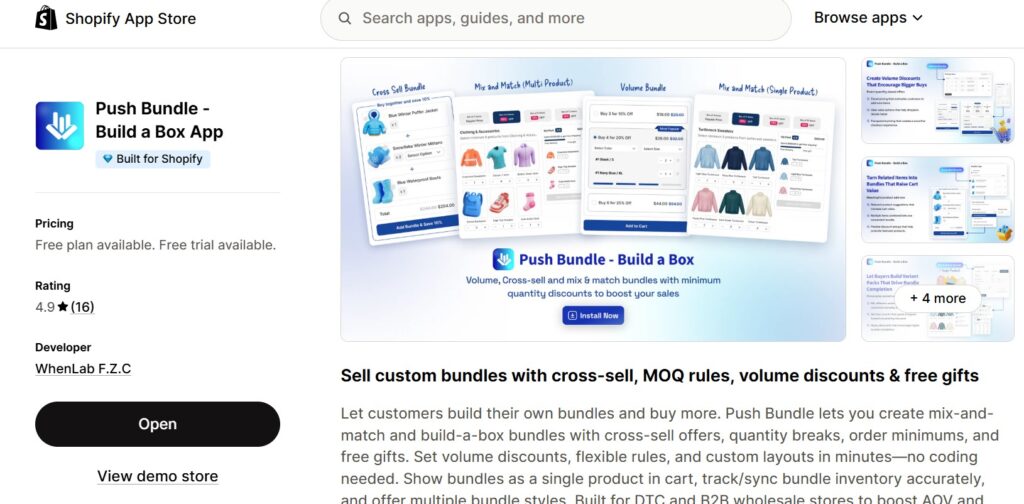
If you are searching for a push bundle vs bundle builder Shopify answer specifically around product flexibility, PushBundle is the stronger place to start. Does the shopper need to choose the bundle contents? If yes, PushBundle deserves serious attention.
Ideal para: Build-a-box offers; mix and match bundles; custom product packs; wholesale bundles; gift box builders; variant-based product selection
Características principales:
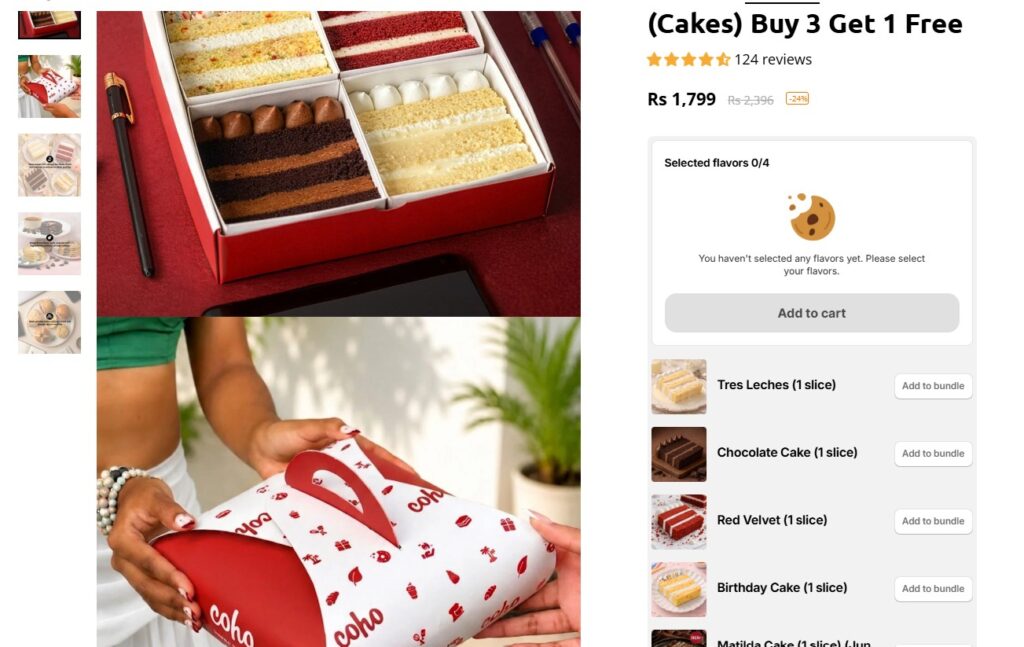
- Mix and match bundles with full variant support
- Build a box bundle flow with guided selection
- Multi-product bundle selection and cross-sell bundles
- Volume discounts and custom quantity packs
- Variant restrictions and quantity limits per variant
- Customer tag-based bundle rules and custom layouts
A bakery can use PushBundle to let customers choose any six pastries from a curated selection.
A denim store can let customers select different sizes and washes inside one pack.
A wholesale snack brand can let retailers choose mixed cases with controlled quantities per SKU.
That is where PushBundle becomes most useful. It handles the buying logic, not just the discount.
Empaquetador
App Details
| Campo | Details |
| Calificación de la aplicación | 4.9 out of 5 |
| Review count | 2,000+ reviews |
| Revelador | Bundler.app |
| Launched | July 2, 2019 |
| Precios | Free plan available. Paid plans start from $9.99/month. |
| Built for Shopify badge | Yes |
| Best fit | Small stores with simple bundle campaigns |
| Strongest use case | Budget-friendly bundle testing with a proven review base |
| Main limitation | Complex customer rules and high-variant products need careful testing |
Bundler is a strong option for stores that want to launch bundle offers quickly without committing to a higher-priced plan. It has been around longer, carries over 2,300 reviews, and is familiar to many Shopify merchants. For the best budget bundle app Shopify searches, Bundler is a natural first candidate.
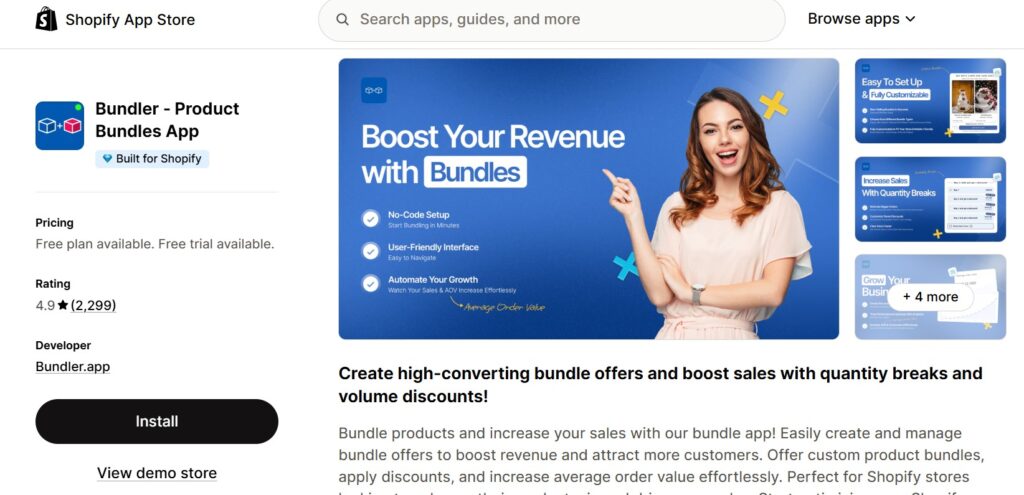
Ideal para: Classic product bundles; volume discounts; quantity breaks; product page upsells; subscription product bundles; stores testing bundle campaigns for the first time
Características principales:
- Classic product bundles and quantity breaks
- Volume discounts and mix and match bundles on paid plans
- Bundle landing pages and product page upsells
- Free shipping offers and funnel upsells
- Subscription product integration
Bundler works well for a coffee store selling two bags plus one mug. It handles a candle brand selling a simple three-scent set cleanly. Where it becomes less clear is advanced variant control. One merchant review on the Shopify App Store noted that Bundler had issues handling products with 80 variants. If customers need to build a bundle across sizes, shades, flavors, or wholesale quantities with per-SKU limits, PushBundle is the safer test.
Pricing Model Comparison
PushBundle vs Bundler pricing is close at the first paid tier, but not identical.
- Bundler: Free plan available. Paid plans start from $9.99/month.
- PushBundle: Plan gratuito disponible. Los planes de pago comienzan desde $14/mes.
That $4 difference matters for a very small store on a tight budget, but it is not the right filter for most merchants. For bundle builder Shopify pricing decisions, compare more than the monthly cost. Compare usage limits, feature restrictions, bundle types available, and whether the app can support your next campaign as well as your current one.
A cheap Shopify bundle app vs enterprise decision should use campaign requirements as the primary filter. A $9.99 app is not cheaper if it cannot handle the bundle type you need. A $14 app is not better if you only need a basic quantity break. Confirm fit first, then confirm cost.
PushBundle vs Bundler: Which App Is Better for Bundle Types
The biggest difference between PushBundle and Bundler shows up when the customer chooses the bundle contents rather than accepting a merchant-defined fixed set.
For a Shopify build a box app comparison, the most important test is not the admin setup. It is the customer flow. Try these four questions with any bundle app you are evaluating:
- Can customers add different products from multiple categories?
- Can they change a variant after initial selection without breaking the bundle?
- Does the discount only apply after the full bundle requirement is met?
- Can the merchant restrict which variants are eligible per product?
Bundler handles fixed sets and simple product bundles well. PushBundle is stronger when the bundle behaves like a custom pack that the customer builds themselves. A tea brand selling fixed tea bundles could use Bundler comfortably. A tea brand letting customers build a six-flavor box should test PushBundle first.
Which App Is Better for Inventory and Variants?
PushBundle is stronger when variant restrictions and custom quantity rules are central to the offer. A PushBundle Shopify review should include a real cart test, not just a feature-list comparison.
For a mix and match bundle app comparison Shopify merchants can trust, test this exact sequence:
- Create a bundle offer with three eligible product variants
- Change one product mid-selection
- Remove one item after adding it
- Check what appears in the cart
- Place a test order through to the order summary
- Check whether the inventory updated correctly per variant
Feature lists show what apps claim to do. Cart behavior shows what they actually do. If your store sells items where size, shade, flavor, or wholesale case packs matter, PushBundle deserves a closer look. If your store sells one-size-fits-all items or simple fixed kits, Bundler may be completely sufficient.
Practical Merchant Scenarios
Scenario 1: Small candle store with 12 SKUs. The bundle is simple. Three scents, no variant restrictions, no complex rules. Bundler handles this well and costs less at the first paid tier.
Scenario 2: Skincare brand with cleanser, serum, and moisturizer across five skin type categories. Customers need to build their own routine. PushBundle is the better fit because variant selection and product group rules matter.
Scenario 3: Bakery selling cookie boxes where customers choose six flavors. PushBundle is the right choice because the customer controls the mix, and the merchant needs to prevent overselling popular flavors.
Scenario 4: Wholesale snack brand letting retailers order mixed cases. PushBundle fits because quantity limits per variant and product selection rules are central to the offer.
Scenario 5: Gym accessories store selling a fixed mat, bottle, and towel set. Bundler handles this type of fixed offer cleanly and does not need the extra complexity of PushBundle.
The pattern is consistent. Fixed bundles work well in Bundler. Shopper-driven bundles work better in PushBundle.
When Should You Choose PushBundle?
PushBundle is the stronger fit when your store needs more than a discount applied to a pre-made set. It suits stores that need:
- Build-a-box offers where the customer builds the pack
- Mix and match product selection across categories or variants
- Variant restrictions that limit what a customer can choose
- Quantity limits per variant inside a bundle
- Customer tag-based bundle rules for wholesale vs retail
- B2B wholesale packs with controlled product selection
- Custom layouts that match your store branding
PushBundle is not just about showing a discount. It is about helping customers build the right bundle the first time, without confusion and without overselling.
When Should You Choose Bundler?
Bundler is the stronger fit when your store wants a proven, budget-friendly bundle app with a large review base. It suits stores that need:
- Classic product bundles with fixed products
- Quantity breaks and volume discounts
- Subscription product integration
- A generous free plan for testing bundle demand
- Fast setup without complex configuration
Bundler is a sensible starting point for stores that are not yet ready for complex bundle logic. If your bundle strategy is still early, Bundler helps you test demand and confirm that bundles drive AOV before investing in more advanced tooling.
Preguntas frecuentes
Is PushBundle cheaper than Bundler?
No. Bundler’s paid plans start from $9.99/month. PushBundle’s paid plans start from $14/month. PushBundle costs more at the first paid tier, but it includes stronger variant restrictions, build-a-box flows, and customer eligibility controls that Bundler does not prioritize.
Which app is better for small Shopify stores?
Bundler is usually better for very small stores with simple fixed bundles or quantity breaks. PushBundle is the stronger fit for growing stores that need configurable packs, B2B bundle rules, or mix and match variant selection.
Does Bundler charge a percentage fee on top of the subscription?
Always check the billing modal on the Shopify App Store before installing. Public app listing pages can change, and the billing screen is the most accurate source for current pricing details.
Can PushBundle handle the same bundle types as Bundler?
They overlap on several bundle types. Both support mix and match and standard product bundles. Bundler is stronger for classic quantity-break deals. PushBundle is stronger for build-your-own bundle flows with variant-level control.
Is Bundler worth $9.99/month for a growing store?
Yes, if the store only needs simple bundles or quantity breaks. Once customer choice, variant rules, or B2B eligibility become important, PushBundle starts to make more sense as the campaign grows.
Which app is better for B2B bundles?
PushBundle is the stronger fit for B2B bundles. It supports customer tag rules, variant limits, quantity controls, and flexible pack building. These are exactly the things B2B buyers need when ordering across sizes, flavors, or product groups.
Should I test both apps before committing?
Yes, if you have a development store. Create one real bundle offer in each app, run it through the actual customer flow, and see how the cart behaves. Feature comparisons are useful. The pattern is clear: Bundler fits fixed bundles well, while PushBundle is stronger for shopper-built bundles.
Conclusión
PushBundle vs Bundler comes down to bundle complexity and who controls the bundle contents. Bundler is the right starting point for stores with simple, fixed offers and a limited budget. PushBundle is the better fit when customers need to build their own bundle and when variant rules, quantity limits, or B2B logic are part of the offer.
Before choosing either app, build one real offer on a test theme. Use actual product variants, apply a real discount, and walk through the full cart experience your customers will see. The right app is not the one with the most reviews or the lower monthly cost. It is the one that makes the bundle feel easy for your customers and manageable for your team. And remember: app ratings, review counts, pricing, and feature names can change. Check each Shopify App Store listing before installing.

Blogs destacados publicaciones

18 de junio de 2026
Limitaciones de los paquetes nativos de Shopify: Explicación de las funciones de combinar productos, 2x1 y creación de cajas.
16 de junio de 2026
 Español
  English
  日本語
日本語  Français
  Deutsch
  简体中文
简体中文  Italiano