Comment créer des offres groupées pour la Saint-Valentin qui génèrent plus de ventes de cadeaux en 2026

Table des matières
- Pourquoi les offres groupées sont la bonne stratégie pour la Saint-Valentin en 2026
- Remises de base ou offres groupées : ce que préfère un client
- Types de coffrets Saint-Valentin que les commerçants peuvent proposer
- Offres groupées de la Saint-Valentin Type#1
- Ensemble Mix and Match Type#2 (Produit unique)
- Ensemble de produits mixtes Type#3 (Plusieurs produits)
- Packs de volume Type#4 pour la Saint-Valentin
- Coffrets cadeaux fixes Type#5
- Coffrets Saint-Valentin personnalisés Type#6
- Packs hybrides numériques et physiques Type#7
- Comment créer un coffret Saint-Valentin (étape par étape)
- Étape #1 Installez l'application
- Étape #2 Sélectionnez la fonction
- Sélection du titre et du produit du pack Step#3
- Étape #4 Créer des packs de quantité
- Affichage de la mise en page Step#5
- Éligibilité et statut du client Step#6
- Étape #7 Options de personnalisation
- Fixer le prix des coffrets Saint-Valentin sans nuire à la valeur de la marque
- Meilleures pratiques pour des coffrets Saint-Valentin à fort taux de conversion
- Erreurs courantes à éviter lors de la confection de coffrets Saint-Valentin
- Comment suivre et mesurer les performances des offres groupées de la Saint-Valentin
- Quand lancer les offres groupées de la Saint-Valentin pour obtenir les meilleurs résultats
- Foire aux questions (FAQ)
- Comment nommer mes paquets de Saint-Valentin ?
- Les offres groupées sont-elles plus avantageuses que les réductions pour la Saint-Valentin ?
- Puis-je proposer à la fois des réductions et des offres groupées ?
- Comment faire la publicité d'un coffret Saint-Valentin ?
- Conclusion
Les achats de la Saint-Valentin sont souvent une affaire d'émotion et de temps. On achète des cadeaux, on ne compare pas les prix. Beaucoup de consommateurs se sentent pressés et indécis, surtout à l'approche de la date. Ils recherchent un cadeau attentionné, sans avoir à trop réfléchir.
Cette urgence se reflète dans les données concrètes. Semaine après semaine, en 2024, l'événement a généré un 6.4% stimule les ventes en ligne Entre le 7 et le 14 février, par rapport à la semaine précédente, cette hausse s'explique par des achats de dernière minute et des achats motivés par la confiance, et non par une recherche attentive des bonnes affaires.
À la Saint-Valentin, les réductions fixes paraissent souvent impersonnelles. Elles font plus penser à une opération promotionnelle qu'à une attention particulière. Les coffrets cadeaux, en revanche, semblent avoir été conçus avec soin. Ils présentent un cadeau complet et facilitent le choix.
La plupart des guides s'arrêtent à dire Les offres groupées augmentent le panier moyen. Ce qu'ils ignorent, c'est que les consommateurs qui font leurs achats pour la Saint-Valentin ne recherchent pas avant tout le prix, mais la confiance. C'est pourquoi les offres groupées pour la Saint-Valentin sont plus performantes que les coupons de réduction pour les achats de cadeaux.
Dans ce blog, vous découvrirez les types de coffrets Saint-Valentin auxquels les clients sont sensibles, comment les créer étape par étape et ce qu'il faut éviter pour que vos offres paraissent faciles à acheter et non forcées.
Avant d'examiner plus en détail les différents formats d'offres groupées, il est utile de comprendre comment fonctionnent ensemble les différents types d'offres groupées à succès pour la Saint-Valentin. Notre guide principal sur Coffrets cadeaux de Noël pour Shopify explique la psychologie des achats motivés par les cadeaux et pourquoi les offres groupées sont plus performantes que les réductions classiques pendant la Saint-Valentin.
Pourquoi les offres groupées sont la bonne stratégie pour la Saint-Valentin en 2026
Pour la Saint-Valentin, les consommateurs recherchent la simplicité et la clarté. Face à l'urgence, parcourir les promotions engendre l'hésitation plutôt que la clarté. Les coffrets cadeaux simplifient la vie en répondant à une question simple : que dois-je acheter ?
Un bon coffret regroupe des articles qui forment un ensemble harmonieux. Cela simplifie le choix du cadeau et inspire confiance. De plus, les coffrets augmentent la valeur perçue sans obliger les marques à baisser leurs prix ni à recourir à des promotions agressives.
Cela est d'autant plus important pour les acheteurs de dernière minute. À l'approche de la Saint-Valentin, les consommateurs cessent de comparer les offres et privilégient les cadeaux sûrs et prêts à offrir. Depuis 2024-2025, cette tendance s'est accentuée. Les acheteurs recherchent la praticité, la confiance et une touche de réconfort. Un coffret Saint-Valentin bien conçu réunit ces trois qualités, ce qui explique pourquoi les coffrets cadeaux sont devenus la stratégie privilégiée en 2026.
Remises de base ou offres groupées : ce que préfère un client
Donc, lot vs réduction, Lequel choisir pour votre magasin à l'occasion de la Saint-Valentin ?
Les remises sont souvent perçues comme de simples transactions. Les clients les considèrent comme des promotions destinées à augmenter les volumes de vente, et non comme des marques d'attention ou d'effort. Une réduction en pourcentage permet certes de faire des économies, mais elle rend rarement un cadeau plus significatif.
Les coffrets de Saint-Valentin suscitent une émotion différente. Ils évoquent l'attention et le sentiment d'avoir fait un cadeau complet. Un coffret ressemble à un présent déjà composé, et non à un article soldé. Cette différence est importante lorsque les clients achètent pour quelqu'un d'autre, et non pour eux-mêmes.
Dans une expérience où l'on propose plusieurs options, une réduction laisse au client le soin de choisir les articles à ajouter et de les personnaliser. Un coffret Saint-Valentin simplifie la tâche. Il offre un choix clair et réduit l'incertitude.
La plupart des guides présentent cela comme une question de prix. En réalité, la Saint-Valentin est un problème de stress lié à la prise de décision, et non un problème de réduction.
Les remises restent pertinentes dans certains cas, comme pour écouler les stocks ou accompagner une offre groupée. Mais, prises isolément, elles sont souvent inefficaces le jour de la Saint-Valentin.
| Aspect | Réduction de base | Coffret Saint-Valentin |
| Première impression | Looks promotionnels | Cela semble intentionnel et axé sur le cadeau. |
| Réponse émotionnelle | Le client doit choisir ce qu'il souhaite ajouter. | “ On sent que tout a été soigneusement pensé. ” |
| effort de décision | Le client doit choisir ce qu'il souhaite ajouter. | Le choix est déjà fait pour eux. |
| Niveau de confiance | Faible à moyen | Haut |
| valeur perçue | Lié à une réduction de prix | Lié à la complétude et au sens |
| Convient pour offrir | Faible | Fort |
| Appel aux acheteurs de dernière minute | Faible | Très haut |
| Perception de la marque | transactionnel | Attentionné et prévenant |
Types de coffrets Saint-Valentin que les commerçants peuvent proposer
Les coffrets cadeaux pour la Saint-Valentin ne se valent pas tous. Le choix idéal dépend du niveau de détail souhaité par vos clients, de leur temps disponible et de la nature de vos produits (cadeaux, par exemple). Voici les coffrets les plus efficaces pour la Saint-Valentin 2026, avec des explications simples et des exemples concrets.
- Vente croisée de coffrets Saint-Valentin
- Ensemble Mix and Match (Produit unique)
- Ensemble Mix and Match (Produits multiples)
- Ensemble de volumes
- Coffrets cadeaux fixes
- Coffrets cadeaux personnalisés pour la Saint-Valentin
- Packs hybrides numériques et physiques
Offres groupées de la Saint-Valentin Type#1
Un ensemble de vente croisée associe un produit de base à un ou deux produits complémentaires. L'objectif n'est pas la variété, mais l'exhaustivité. Ces ensembles sont particulièrement efficaces lorsque les produits complémentaires donnent au cadeau principal une impression de finition et de prêt à offrir.
Cette approche est particulièrement efficace pour les marques de bijoux, de cosmétiques, d'articles de mode et d'alimentation. Les clients souhaitent déjà le produit principal, et le coffret leur évite d'avoir à se soucier des accessoires.
Exemple : un collier accompagné d’une boîte cadeau et d’une carte manuscrite. Le collier est joli en soi. Ensemble, ils forment un cadeau de Saint-Valentin prêt à offrir.
Ensemble Mix and Match Type#2 (Produit unique)
Ce forfait permet aux clients de choisir plusieurs variantes d'un même produit. Il est idéal lorsque les acheteurs recherchent de la flexibilité sans complexité. Le produit reste familier, mais l'expérience est plus personnalisée.
C'est idéal pour les chocolats, les bougies, les soins de la peau, les en-cas ou tout produit décliné en plusieurs saveurs, parfums ou couleurs. En magasin, cela permet également de réduire le nombre de références tout en augmentant le panier moyen.
Exemple : choisissez 6 chocolats parmi 10 saveurs pour composer votre coffret de Saint-Valentin. Le client se sent impliqué, mais le choix reste simple.
Ensemble de produits mixtes Type#3 (Plusieurs produits)
Un assortiment de produits variés permet aux clients de composer leur propre coffret cadeau de Saint-Valentin à partir de différents articles. Cela leur offre un choix personnalisé et donne l'impression d'un cadeau unique, loin des produits de masse.
Ce format est idéal pour offrir des marques proposant des gammes de produits complémentaires. Il séduit également les consommateurs qui recherchent un cadeau plus personnalisé qu'un coffret standard.
Exemple : composez un coffret Saint-Valentin en choisissant une bougie, un chocolat et un petit accessoire. Le coffret semble personnalisé, même si la structure est prédéfinie.
Packs de volume Type#4 pour la Saint-Valentin
Les offres groupées privilégient la quantité à la variété. Les clients achètent plusieurs articles ensemble pour un meilleur rapport qualité-prix, sans que la marque ait besoin de recourir à des remises importantes. L'astuce consiste à présenter l'offre comme un ensemble, et non comme une vente en gros.
Ces coffrets sont idéaux pour les produits consommables et les articles à usage fréquent. Ils conviennent également pour se faire plaisir ou pour composer des coffrets pour couples, où l'achat de plusieurs exemplaires est judicieux.
Exemple : offrir un coffret de trois bougies pour la Saint-Valentin et créer des ambiances cocooning. Le cadeau est pratique, mais la présentation reste soignée.
Coffrets cadeaux fixes Type#5
Les coffrets cadeaux pré-emballés sont prêts à offrir et ne nécessitent aucune personnalisation. Ils sont conçus pour une livraison rapide et sans tracas, notamment à l'approche de la Saint-Valentin. Les clients veulent une solution simple et efficace.
Ces offres groupées sont très appréciées des clients qui font leurs achats à la dernière minute car elles réduisent les frictions et accélèrent le passage en caisse.
Exemple : un coffret cadeau de Saint-Valentin pré-composé avec une bougie, des chocolats et une carte. Un clic, une décision, un cadeau prêt à offrir.
Coffrets Saint-Valentin personnalisés Type#6
Les coffrets personnalisés ajoutent une valeur émotionnelle grâce à un message, un nom ou une gravure sur mesure. Ils misent moins sur les réductions que sur la signification, ce qui les rend particulièrement attractifs, même à des prix plus élevés.
Ces offres groupées fonctionnent mieux lorsque la personnalisation est intentionnelle et limitée, et non excessive.
Exemple : un coffret bracelet avec un court message gravé et une carte de Saint-Valentin imprimée. Le client paie pour une émotion, pas seulement pour des produits.
Packs hybrides numériques et physiques Type#7
Les coffrets hybrides associent un cadeau physique à un élément numérique, comme un message instantané, une note QR ou une carte virtuelle. Ils permettent de résoudre les problèmes courants de la Saint-Valentin, tels que les cadeaux envoyés à distance et les achats de dernière minute.
Ce format est particulièrement utile pour les acheteurs qui effectuent leurs achats à l'approche de la date de livraison, période où l'anxiété liée à la livraison est forte.
Exemple : un cadeau physique expédié de façon classique, accompagné d’un message numérique instantané pour la Saint-Valentin envoyé au moment du paiement. Le cadeau est offert immédiatement, même si la livraison prend du temps.
Comment créer un coffret Saint-Valentin (étape par étape)
Si vous vous dites : “ Super, mais comment faire concrètement ? ”, voici une configuration rapide.
- Installer l'application
- Sélectionnez la fonctionnalité
- Titre du lot et sélection de produits
- Créer des packs de quantité
- Affichage de la mise en page
- Admissibilité et statut du client
- Options de personnalisation
Étape #1 Installez l'application
Installez le Application groupée Shopify depuis l'App Store de Shopify.
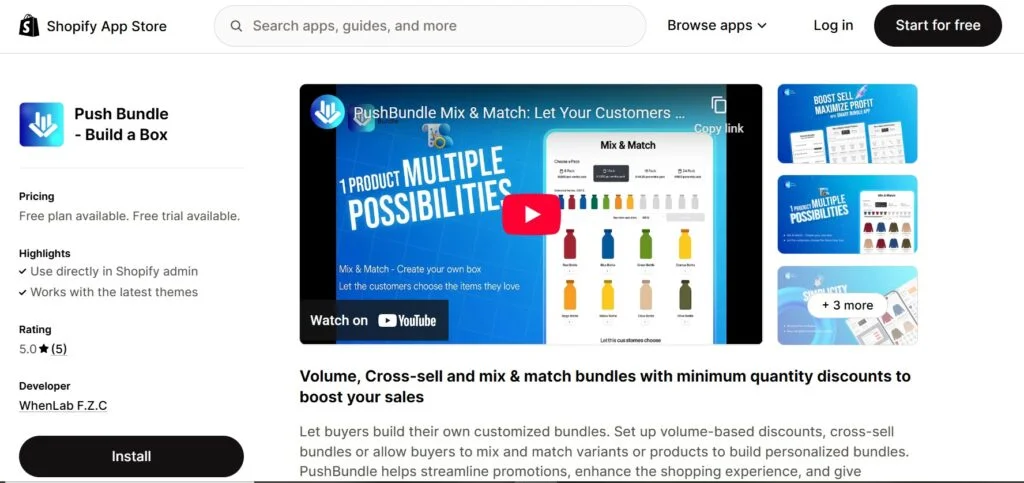
Étape #2 Sélectionnez la fonction
Depuis le tableau de bord de l'application, vous trouverez un menu déroulant “ Créer un pack ”. Pour le moment, quatre types de packs sont disponibles.
- Ensemble de volumes
- Combinaisons possibles (produit unique)
- Combinez et assortissez (plusieurs produits)
- Offre groupée de vente croisée
Pour celui-ci, nous présentons un exemple de combinaison (plusieurs produits).
Sélection du titre et du produit du pack Step#3
Après avoir sélectionné la fonctionnalité, vous verrez d'abord deux sections : « Informations sur le pack » et « Sélectionner un produit ».
Ajoutez un titre. Voici ce que vos clients verront sur la page produit, dans leur panier et au moment du paiement. Soyez clair. Utilisez des noms qui décrivent le produit. sentiment ou la finalité du cadeau, et non son contenu. Les consommateurs sont plus sensibles aux signaux émotionnels qu'aux listes de produits.
Écrivez une courte description. Vous disposez de 150 caractères maximum. Soyez donc concis et expliquez le contenu de l'offre en termes simples.
Ensuite, accédez à l'encadré “ Sélectionnez un produit ”. C'est ici que vous choisissez les produits concernés par l'offre groupée. Assurez-vous que les produits de l'offre sont compatibles entre eux. Cliquez sur “ Parcourir ” pour afficher la liste complète des produits.
Étape #4 Créer des packs de quantité
Vous verrez ensuite la section « Packs de quantité ». Vous pourrez y créer différents packs pour vos produits.
Nommez clairement votre pack afin que les clients sachent de quoi il s'agit.
- Choisissez la quantité (par exemple, Pack 1, Pack 2).
- Choisissez un type de réduction : pourcentage, montant fixe ou aucune réduction. Si vous sélectionnez “ aucune réduction ”, l’application calculera simplement le prix total des différentes options.
- Dans notre exemple, si un client achète un « Pack 1 », il bénéficie d'une réduction de 5%.
Vous pouvez également ajouter des remises pour les packs multiples. Par exemple, si un client achète vingt packs « Pack 2 », la remise passe à 15%. Vous pouvez configurer plusieurs règles pour les packs multiples.
Enfin, il existe des limites avancées (facultatives). Vous pouvez ainsi contrôler le nombre de variantes qu'un client peut choisir et le nombre de variantes qu'il peut ajouter.
Affichage de la mise en page Step#5
Pour l'affichage, vous avez deux choix : le modèle de barre supérieure ou le modèle de barre latérale. Choisissez celui qui s'intègre le mieux à votre boutique.
Il existe également une option « Modifier l'icône ». Vous pouvez y importer une icône en forme de boîte ou des icônes d'espace réservé pour les produits. Cette option est utile si vous souhaitez que le pack soit plus visuel et reflète votre marque.
Enfin, n'oubliez pas d'ajouter un sous-titre à l'étiquette de votre pack. Cela permettra aux clients d'avoir une idée plus claire du contenu du pack et de rendre l'offre plus compréhensible au premier coup d'œil.
Éligibilité et statut du client Step#6
Vous pouvez également choisir qui peut voir le pack. Rendez-le visible à tous les clients, limitez-le à certains tags client, voire à des clients spécifiques. Les packs peuvent être activés ou désactivés à tout moment.
Étape #7 Options de personnalisation
Tout en bas du formulaire, vous trouverez un bouton « Options avancées ». C'est ici que vous pouvez affiner l'apparence et le comportement de l'offre pour les acheteurs. Les quatre options disponibles sont :
- Paramètres d’affichage – contrôlez la façon dont le bundle s’affiche sur la page.
- Personnalisation du thème – adaptez l'apparence à l'image de marque de votre boutique.
- Ajouter au panier – modifiez le fonctionnement et l’apparence du bouton Ajouter au panier.
- CSS personnalisé – pour des ajustements de conception plus approfondis si vous souhaitez plus de contrôle.
Une fois vos sélections effectuées, n'oubliez pas de cliquer sur Enregistrer.
Regardez cette vidéo si besoin !
Fixer le prix des coffrets Saint-Valentin sans nuire à la valeur de la marque
Pour la Saint-Valentin, la valeur perçue prime sur les réductions en pourcentage. Les consommateurs achètent un cadeau, pas une bonne affaire, et des baisses de prix importantes peuvent dévaloriser le produit. Un coffret à prix attractif est apprécié car il paraît complet et réfléchi, et non parce qu'il est moins cher.
L'ancrage est essentiel. Lorsque les clients perçoivent d'abord la valeur combinée des articles individuels, le prix du lot leur paraît justifié, même sans réduction importante. Bien souvent, un petit avantage, comme un emballage cadeau offert ou un bonus, est plus efficace qu'une forte baisse de prix. Il apporte de la valeur sans pour autant diminuer les attentes.
L'objectif est d'éviter une course au moins-disant. Les coffrets Saint-Valentin doivent préserver l'image de marque tout en rassurant et en instaurant un climat de confiance lors de l'achat.
Meilleures pratiques pour des coffrets Saint-Valentin à fort taux de conversion
Les coffrets Saint-Valentin les plus réussis sont simples, clairs et inspirent confiance. Les petits détails de la présentation et de la composition comptent souvent plus que le prix lui-même.
- Limitez le choix des offres groupées : Un trop grand choix engendre l'hésitation. Proposer deux ou trois offres groupées claires aide les consommateurs à se décider plus rapidement, surtout lorsqu'ils achètent dans l'urgence.
- Utilisez une appellation et des visuels spécifiques à la Saint-Valentin : Les noms et visuels saisonniers donnent à l'ensemble un aspect soigné. Des étiquettes génériques, en revanche, donnent l'impression d'une offre déjà vue ou bâclée.
- Présenter les lots comme un seul cadeau complet : Présentez le coffret comme un produit unique, et non comme une liste d'articles. Cela renforce l'idée que le cadeau est déjà soigneusement composé.
- Indiquez à qui s'adresse ce forfait : Des indications claires comme “ pour elle ”, “ pour les couples ” ou “ cadeau de dernière minute ” aident les acheteurs à voir rapidement si le coffret correspond à leurs besoins.
- Rendre le timing de livraison impossible à manquer : Des délais de livraison clairs réduisent l'anxiété et évitent les abandons de panier, surtout à l'approche de la Saint-Valentin.
Erreurs courantes à éviter lors de la confection de coffrets Saint-Valentin
Même les offres groupées les mieux conçues peuvent échouer si elles créent des frictions ou de la confusion. Ce sont les erreurs les plus fréquentes qui nuisent aux conversions.
- Sur-personnalisation : Trop de choix transforment un coffret en une composition complexe. Les clients qui font leurs achats pour la Saint-Valentin recherchent des conseils, pas un contrôle total.
- Trop de niveaux d'abonnement : Un nombre excessif de niveaux engendre une lassitude face à la comparaison. Chaque option supplémentaire augmente le risque de ne prendre aucune décision.
- Noms génériques des produits : Les noms dénués d'émotion ne créent pas de lien. Les cadeaux de la Saint-Valentin doivent avoir une dimension personnelle, et non pas être de simples objets utilitaires.
- Dissimuler les délais de livraison : Des informations de livraison imprécises engendrent des doutes. Les acheteurs hésitent lorsqu'ils ne sont pas certains que leur cadeau arrivera à temps.
- Traiter les offres groupées comme des réductions : Présenter les coffrets comme des offres promotionnelles leur enlève toute valeur émotionnelle. Un coffret doit être perçu comme une solution cadeau, et non comme une technique de vente.
Comment suivre et mesurer les performances des offres groupées de la Saint-Valentin
Le chiffre d'affaires ne suffit pas à lui seul pour évaluer la performance de vos offres spéciales Saint-Valentin. Ces offres étant conçues pour réduire les hésitations et renforcer la confiance, il est essentiel d'analyser les indicateurs de comportement d'achat, et pas seulement le montant des ventes.
Des indicateurs plus importants que le chiffre d'affaires
Privilégiez les indicateurs comportementaux qui montrent si les offres groupées facilitent les décisions. Ces indicateurs révèlent souvent le succès avant même que le chiffre d'affaires ne se manifeste.
taux de conversion des lots
Suivez la fréquence à laquelle les visiteurs qui consultent une offre groupée l'achètent. Un taux de conversion élevé indique généralement que l'offre est perçue comme claire, complète et digne de confiance.
Augmentation du panier moyen grâce aux offres groupées
Comparez la valeur moyenne des commandes groupées à celle des achats de produits individuels. Cela permet de déterminer si les offres groupées augmentent le panier moyen sans imposer de réductions.
Abandon de panier pour les produits groupés
Un taux d'abandon plus faible indique souvent que le prix, le délai de livraison et la clarté de l'offre fonctionnent de concert.
Comparaison des performances avec et sans forfait groupé
Les comparaisons côte à côte vous aident à comprendre si les offres groupées améliorent la confiance, et ne se contentent pas de modifier les ventes.
Quand lancer les offres groupées de la Saint-Valentin pour obtenir les meilleurs résultats
Le timing est un facteur déterminant pour le succès des offres spéciales Saint-Valentin. Le comportement des consommateurs varie selon la proximité de la date, et votre stratégie de lancement doit en tenir compte.
- Planification anticipée vs achats de dernière minute : Les clients qui s'y prennent à l'avance recherchent des cadeaux attentionnés et personnalisés. Ceux qui achètent à la dernière minute privilégient la rapidité et la certitude. Vos coffrets cadeaux doivent répondre à ces deux besoins.
- Lancement en douceur vs promotion agressive : Un lancement progressif permet d'indexer, de tester et d'optimiser les offres. Un lancement trop agressif et prématuré risque de vous enfermer dans un discours qui ne correspond plus aux attentes des acheteurs.
- Mise à jour des messages groupés à l'approche du 14 février : À mesure que la date approche, concentrez-vous sur les délais de livraison, la préparation des cadeaux et la simplicité. Ce qui fonctionnait il y a deux semaines ne convaincra peut-être pas les acheteurs de dernière minute.
Lancer les offres groupées tôt et adapter le message au fil du temps leur donne les meilleures chances de conversion pendant toute la période d'achat de la Saint-Valentin.
Foire aux questions (FAQ)
Consultez notre liste de questions fréquemment posées sur coffrets cadeaux pour la Saint-Valentin.
Comment nommer mes paquets de Saint-Valentin ?
Utilisez des noms qui décrivent le sentiment ou la finalité du cadeau, et non son contenu. Les consommateurs sont plus sensibles aux signaux émotionnels qu'aux listes de produits.
Les offres groupées sont-elles plus avantageuses que les réductions pour la Saint-Valentin ?
Dans la plupart des cas, oui. Les offres groupées réduisent le stress lié au choix et sont perçues comme une attention plus réfléchie que les réductions fixes. À l'occasion de la Saint-Valentin, les consommateurs achètent des cadeaux, pas des produits à prix réduit. Une offre groupée bien conçue se vend souvent mieux car elle propose une solution complète plutôt qu'une simple réduction.
Puis-je proposer à la fois des réductions et des offres groupées ?
Oui, mais avec précaution. De petits avantages peuvent valoriser un lot, comme la livraison gratuite ou un article bonus. Des réductions importantes peuvent en revanche diminuer la valeur perçue. Le lot doit rester l'attrait principal, et non la réduction.
Comment faire la publicité d'un coffret Saint-Valentin ?
Misez sur la clarté et le timing. Indiquez clairement à qui est destiné le coffret, ce qu'il contient et les dates limites de livraison. Privilégiez un discours axé sur les cadeaux dans vos e-mails, sur les pages produits et sur les réseaux sociaux plutôt qu'un langage trop promotionnel.
Conclusion
Les achats de la Saint-Valentin sont guidés par l'émotion, et non par la comparaison des prix. Les clients veulent être sûrs de leur choix, surtout lorsqu'ils achètent un cadeau dans l'urgence. Les coffrets cadeaux fonctionnent car ils éliminent les incertitudes et proposent une solution complète, plutôt que de laisser les acheteurs composer eux-mêmes leur cadeau.
En simplifiant les décisions, les offres groupées renforcent la confiance et réduisent les hésitations au moment du paiement. En 2026, cette approche est plus pertinente que jamais. Des offres groupées bien pensées sont systématiquement plus performantes que des remises agressives, qui peuvent donner aux cadeaux un aspect impersonnel et purement transactionnel.
Le succès de vos coffrets pour la Saint-Valentin repose sur la clarté, non sur la complexité. Lorsque vos coffrets sont bien pensés, prêts à offrir et faciles à commander, les clients sont bien plus enclins à dire oui.
Vérifié pour son exactitude
Cet article a été révisé par l'équipe de support technique PushBundle, qui aide régulièrement les marchands Shopify à tester la configuration des offres groupées, les règles de sélection de produits, la tarification des bundles, le comportement du panier et les problèmes liés au paiement.
À propos de l'auteur

Syeda Rehnoma Tanzom
Contributeur PushBundle
This article is written by Syeda Rehnoma Tanzom, an SEO content writer with 3+ years of experience specializing in eCommerce content. What makes the work here a little different? A close collaboration with support teams to understand what merchants are actually going through, their frustrations, their questions, and their wins. The goal is simple: write content that speaks to real problems, not just search engines. When not buried in keywords and content briefs, you'll find her nose-deep in a good book, binge-watching true crime documentaries or psychological thrillers, and occasionally switching gears with a feel-good rom-com.