Valentine’s shopping is emotional and time-sensitive. People are buying gifts, not comparing prices. Many shoppers feel rushed and unsure, especially as the date gets closer. They want something that feels thoughtful without needing too much decision-making.
This urgency shows up in real data. Week-on-week, in 2024, the event delivered a 6.4% boost to e-commerce sales between 7–14 February compared to the previous week. That increase comes from last-minute and confidence-driven purchases, not careful deal hunting.
On valentines day, flat discounts often feel generic. They look promotional rather than personal. Bundles, on the other hand, feel intentional. They present a complete gift and make the choice easier.
Most guides stop at saying bundles increase AOV. What they miss is that Valentine’s shoppers are not optimizing for price. They are optimizing for confidence. That is why valentines bundle strategies outperform coupons for gift sales.
In this blog, you’ll learn the types of Valentine bundles customers respond to, how to build them step by step, and what to avoid so your offers feel easy to buy, not forced.
Table of Contents
Before diving deeper into specific bundle formats, it helps to understand how all successful Valentine bundle types work together. Our main guide on Holiday Gift Bundles for Shopify explains the psychology behind gift-driven buying and why bundles outperform basic discounts during Valentine’s Day.
Why Bundling Is the Right Valentine’s Strategy in 2026
Valentine’s shoppers want fewer decisions, not more offers. When the clock is ticking, scrolling through discounts creates hesitation instead of clarity. Bundles remove that pressure by answering a simple question: what should I buy?
A good bundle groups items that feel complete together. That makes the gift easier to choose and easier to trust. At the same time, bundles increase perceived value without forcing brands to lower prices or rely on aggressive promotions.
This matters even more for late buyers. As Valentine’s Day gets closer, shoppers stop comparing deals and start looking for safe, gift-ready options. Since 2024–2025, this shift has become clearer. Buyers expect convenience, confidence, and emotional reassurance. A well-designed valentines bundle delivers all three, which is why bundling has become the stronger strategy in 2026.
Basic Discounts vs Bundles: What A Customer Prefers
So, bundle vs discount, which one should you choose for your store this valentine’s day?
Discounts often feel transactional. Customers see them as promotions designed to push volume, not as signals of care or effort. A percentage off might save money, but it rarely makes a gift feel more meaningful.
Valentine’s bundles create a different emotional response. They suggest thoughtfulness and completeness. A bundle looks like a ready-made gift, not a discounted product. That difference matters when shoppers are buying for someone else, not for themselves.
In a side-by-side experience, a discount asks the customer to decide what to add and how to make it special. A valentines bundle removes that work. It presents a clear choice and reduces uncertainty.
Most guides frame this as a pricing decision. In reality, Valentine’s Day is a decision-stress problem, not a discount problem.
Discounts still make sense in limited cases, such as clearing inventory or supporting a bundle offer. But on their own, this is why discounts fail on Valentine’s Day.
| Aspect | Basic Discount | Valentines Bundle |
| First impression | Looks promotional | Feels intentional and gift-focused |
| Emotional response | The customer must choose what to add | “This feels thoughtfully put together.” |
| Decision effort | Customer must choose what to add | Choice is already made for them |
| Confidence level | Low to medium | High |
| Perceived value | Tied to price reduction | Tied to completeness and meaning |
| Suitability for gifting | Weak | Strong |
| Appeal to last-minute buyers | Low | Very high |
| Brand perception | Transactional | Caring and considered |
Types of Valentine’s Bundles Merchants Can Offer
Not all Valentine’s bundles work the same way. The best option depends on how much choice your customers want, how rushed they are, and how gift-focused your products are. Below are the most effective bundle types for Valentine’s Day 2026, with simple explanations and practical examples.
- Cross-sell Valentine’s bundles
- Mix and Match Bundle (Single Product)
- Mix and Match Bundle (Multiple Products)
- Volume Bundle
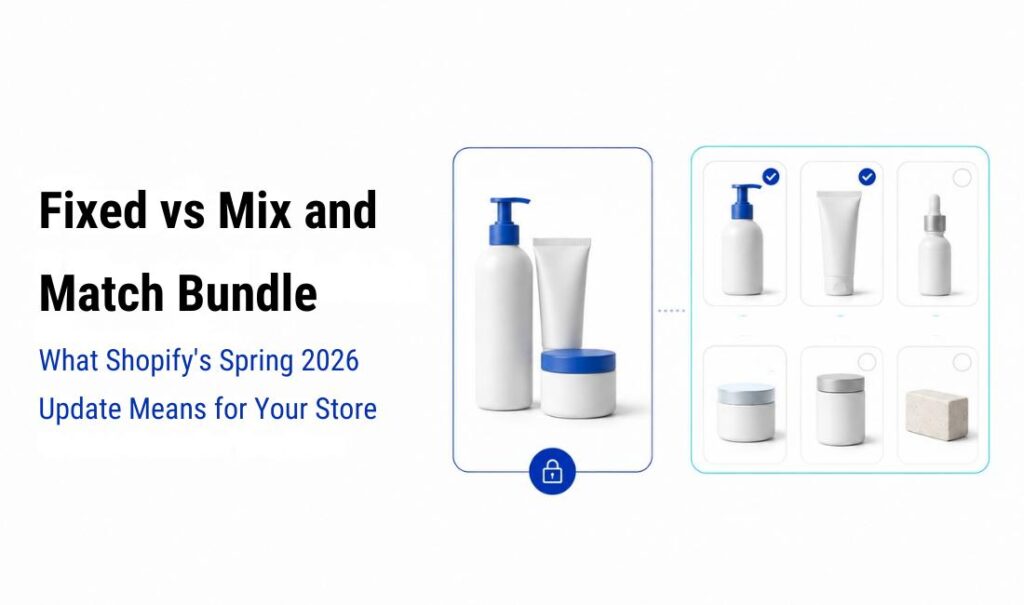
- Fixed Gift Box Bundles
- Personalized Valentine’s Bundles
- Digital + Physical Hybrid Bundles
Type#1 Cross-Sell Valentine’s Bundles
A cross-sell bundle combines a core product with one or two complementary add-ons. The goal is not variety, but completeness. These bundles work best when the add-ons make the main gift feel finished and gift-ready.
This approach is especially effective for jewelry, beauty, lifestyle, and food brands. Customers already want the main item, and the bundle removes the need to think about extras.
Example: a necklace paired with a gift box and a handwritten note card. On its own, the necklace is nice. As a bundle, it becomes a ready-to-give Valentine’s gift.
Type#2 Mix and Match Bundle (Single Product)
This bundle allows customers to choose multiple variants of the same product. It works well when shoppers want flexibility without complexity. The product stays familiar, but the experience feels more personal.
It is ideal for chocolates, candles, skincare, snacks, or any product with multiple flavors, scents, or shades. From a store perspective, this also reduces SKU clutter while increasing average order value.
Example: choose any 6 chocolates from 10 flavors to create one Valentine’s box. The customer feels involved, but the decision stays simple.
Type#3 Mix and Match Bundle (Multiple Products)
A multi-product mix and match bundle lets customers build their own Valentine gift box from different products. This gives shoppers control and makes the gift feel curated rather than mass-produced.
This format works best for gifting brands with complementary product lines. It also appeals to shoppers who want something more personal than a fixed bundle.
Example: build a Valentine box by choosing one candle, one chocolate, and one small accessory. The bundle feels custom, even though the structure is guided.
Type#4 Volume Bundles for Valentine’s Day
Volume bundles focus on quantity, not variety. Customers buy more items together for a better overall value, without the brand relying on heavy discounts. The key is framing it as a set, not a bulk deal.
These bundles work best for consumables and repeat-use items. They are also effective for self-love gifting or couple sets, where buying multiples makes sense.
Example: buy three candles as a Valentine’s set for cozy nights in. The value feels practical, but the presentation still feels intentional.
Type#5 Fixed Gift Box Bundles
Fixed gift box bundles are pre-packed and require no customization. They are designed for speed and confidence, especially close to Valentine’s Day. Customers do not want to think. They want something that works.
These bundles perform very well with last-minute shoppers because they reduce friction and speed up checkout.
Example: a pre-designed Valentine gift box with a candle, chocolates, and a card. One click, one decision, one complete gift.
Type#6 Personalized Valentine’s Bundles
Personalized bundles add emotional value through a custom message, name, or engraving. They rely less on discounts and more on meaning. This makes them powerful even at higher price points.
These bundles work best when personalization feels intentional and limited, not overwhelming.
Example: a bracelet bundle with a short engraved message and a printed Valentine’s note. The customer pays for emotion, not just products.
Type#7 Digital + Physical Hybrid Bundles
Hybrid bundles combine a physical gift with a digital element, such as an instant message, QR note, or digital card. They solve common Valentine’s Day problems like long-distance gifting and late-night purchases.
This format is especially useful for shoppers buying close to the date, when delivery anxiety is high.
Example: a physical gift shipped normally, paired with an instant digital Valentine message sent at checkout. The gift feels immediate, even if shipping takes time.
How to Create a Valentine’s Bundle (Step-by-Step)
If you’re thinking, “Great, but how do I actually do this?” Here’s the quick setup.
- Install the app
- Select the feature
- Bundle Title & Product Selection
- Create Quantity Packs
- Layout Display
- Customer Eligibility and Status
- Customizing Options
Step#1 Install the app
Install the Shopify bundle app from the Shopify App Store.
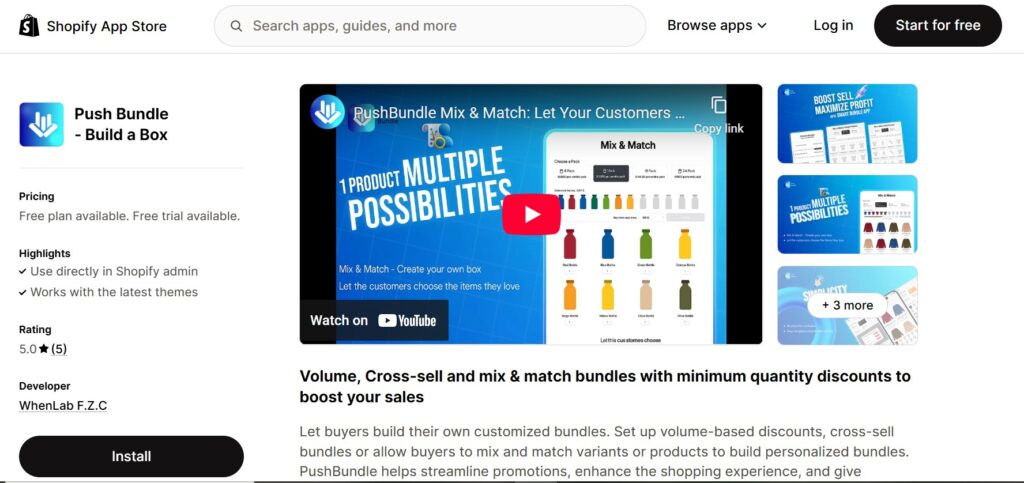
Step#2 Select the feature
From the app’s dashboard, you’ll find a dropdown “Create Bundle”. For now, there are four types of bundles available.
- Volume Bundle
- Mix and Match (Single Product)
- Mix and Match (Multiple Products)
- Cross-sell bundle
For this one, we’re showing mix and match (multiple products) as an example.
Step#3 Bundle Title & Product Selection
After selecting the feature, you’ll first see two sections: “Bundle Information” and “Select a Product.”
Add a title. This is what your customers will see on the product page, in their cart, and at checkout. Keep it clear. Use names that describe the feeling or purpose of the gift, not the contents. Shoppers respond better to emotional cues than product lists.
Write a short description. You’ve got up to 150 characters. So keep it simple, something that explains the bundle in plain words.
Next, head to the “Select a Product” box. This is where you decide which products the bundle applies to. Make sure the products in the bundle work well together. Click “Browse” and you’ll see your full product list.
Step#4 Create Quantity Packs
You’ll see a “Quantity Packs” section next. This is where you can create different packs for your products.
Name your pack clearly so customers know what it is.
- Choose the quantity (e.g., Pack 1, Pack 2).
- Pick a discount type – percentage, fixed amount, or no discount at all. If you select “no discount,” the app will simply total up the variant prices.
- In our example, if a customer buys one ‘Pack 1,’ they get 5% off.
You can also add multi-pack discounts. For example, if a customer buys twenty “Pack 2” packs, the discount jumps to 15%. You’re free to set up multiple multi-pack rules.
Finally, there are advanced limits (optional). Here, you can control how many variants a customer can choose and how many of each they’re allowed to add.
Step#5 Layout Display
For the layout display, you’ll have two choices: Top Bar template or Side Bar template. Pick the one that fits best with your store design.
There’s also a “Change Icon” option. Here you can upload a box icon or placeholder icons for products. It’ll be helpful if you want the bundle to feel more visual and branded.
Finally, don’t forget to add a subtitle to your pack label. This gives customers a clearer idea of what the pack includes, making the offer more understandable at first glance.
Step#6 Customer Eligibility and Status
You can also choose who can see the bundle. Make it visible to all customers, limit it to certain customer tags, or even specific customers. Bundles can be activated or deactivated anytime.
Step#7 Customizing Options
At the very end of the form, you’ll see an “Advanced Options” button. This is where you can fine-tune how the offer looks and behaves for shoppers. The four areas you can adjust are:
- Display settings – control how the bundle shows up on the page.
- Theme customization – match the look to your store’s branding.
- Add to cart – edit how the add-to-cart button works and appears.
- Custom CSS – for deeper design tweaks if you want more control.
Once you’ve made your selections, don’t forget to hit Save.
Watch this video if you need!
Pricing Valentine’s Bundles Without Hurting Brand Value
On Valentine’s Day, perceived value matters more than percentage discounts. Shoppers are buying a gift, not a deal, and heavy price cuts can make the product feel less special. A well-priced bundle works because it feels complete and intentional, not because it is cheaper.
Anchoring is key. When customers see the combined value of individual items first, the bundle price feels justified, even without a large discount. In many cases, a small incentive, such as free gift wrapping or a bonus add-on, performs better than a big price reduction. It adds value without lowering expectations.
The goal is to avoid a race to the bottom. Valentine’s bundles should protect brand perception while making the buying decision feel safe and confident.
Best Practices for High-Converting Valentine’s Bundles
Strong Valentine bundles are simple, clear, and easy to trust. Small details in presentation and structure often matter more than pricing itself.
- Keep bundle choices limited: Too many options create hesitation. Two or three clear bundle choices help shoppers decide faster, especially when they are buying under time pressure.
- Use Valentine-specific naming and visuals: Seasonal names and visuals help the bundle feel intentional. Generic labels make the offer feel reused or rushed.
- Show bundles as one complete gift: Present the bundle as a single product, not a list of items. This reinforces the idea that the gift is already thoughtfully put together.
- Highlight who the bundle is for: Clear cues like “for her,” “for couples,” or “last-minute gift” help shoppers quickly see if the bundle fits their needs.
- Make delivery timing impossible to miss: Clear delivery deadlines reduce anxiety and prevent abandoned carts, especially close to Valentine’s Day.
Common Valentine’s Bundle Mistakes to Avoid
Even well-intended bundles can fail if they add friction or confusion. These are the most common mistakes that hurt conversions.
- Over-customization: Too many choices turn a bundle into a complex build. Valentine shoppers want guidance, not control.
- Too many bundle tiers: Excessive tiers create comparison fatigue. Each extra option increases the chance of no decision at all.
- Generic product names: Names that lack emotion fail to connect. Valentine’s bundles should feel personal, not operational.
- Hiding delivery deadlines: Unclear shipping information creates doubt. Shoppers hesitate when they are unsure a gift will arrive on time.
- Treating bundles like discounts: Positioning bundles as promotions removes their emotional value. A bundle should feel like a gift solution, not a sales tactic.
How to Track and Measure Valentine’s Bundle Performance
Revenue alone does not tell the full story of how your Valentine’s bundles are performing. Because bundles are designed to reduce hesitation and increase confidence, you need to look at signals that reflect buying behavior, not just sales totals.
Metrics that matter more than revenue
Focus on behavior-based metrics that show whether bundles are making decisions easier. These often reveal success earlier than revenue does.
Bundle conversion rate
Track how often visitors who view a bundle actually purchase it. A strong conversion rate usually means the bundle feels clear, complete, and trustworthy.
AOV uplift from bundles
Compare the average order value of bundle purchases against regular product purchases. This shows whether bundles are increasing basket size without forcing discounts.
Cart abandonment on bundled products
Lower abandonment often indicates that pricing, delivery timing, and bundle clarity are working together.
Comparing bundle vs non-bundle performance
Side-by-side comparisons help you understand whether bundles are improving confidence, not just shifting sales.
When to Launch Valentine’s Bundles for Best Results
Timing plays a major role in how Valentine’s bundles perform. Shoppers behave differently depending on how close they are to the date, and your launch strategy should reflect that.
- Early planners vs last-minute buyers: Early shoppers look for thoughtful gifts and customization. Last-minute buyers prioritize speed and certainty. Your bundles should support both mindsets.
- Soft launch vs hard promotion: A soft launch helps bundles get indexed, tested, and refined. A hard push too early can lock you into messaging that no longer fits buyer urgency.
- Updating bundle messaging closer to Feb 14: As the date approaches, shift focus to delivery deadlines, gift readiness, and simplicity. What worked two weeks earlier may not convert late buyers.
Launching early and adapting messaging over time gives bundles the best chance to convert across the full Valentine’s buying window.
Frequently Asked Questions (FAQ)
Read our list of frequently asked questions on valentine’s day bundles.
How do I name valentine packages?
Use names that describe the feeling or purpose of the gift, not the contents. Shoppers respond better to emotional cues than product lists.
Are bundles better than discounts for Valentine’s Day?
In most cases, yes. Bundles reduce decision stress and feel more thoughtful than flat discounts. Valentine’s shoppers are buying gifts, not optimizing for savings. A well-designed bundle often converts better because it presents a complete solution instead of a price cut.
Can I offer both discounts and bundles together?
Yes, but carefully. Small incentives can support a bundle, such as free shipping or a bonus item. Large discounts can weaken the perceived value of the gift. The bundle should remain the main attraction, not the discount.
How to advertise a Valentine’s package?
Focus on clarity and timing. Highlight who the bundle is for, what’s included, and delivery cutoffs. Use gift-focused messaging in emails, on product pages, and in social posts rather than promotion-heavy language.
Conclusion
Valentine’s Day purchases are driven by emotion, not price comparison. Customers want to feel confident about their choice, especially when they are buying a gift under time pressure. Bundles work because they remove uncertainty and present a complete solution, rather than forcing shoppers to build a gift themselves.
By simplifying decisions, bundles increase confidence and reduce hesitation at checkout. In 2026, this approach matters more than ever. Thoughtful bundling consistently performs better than aggressive discounting, which can make gifts feel generic and transactional.
Valentine’s success comes from clarity, not complexity. When your bundles feel intentional, gift-ready, and easy to buy, customers are far more likely to say yes.


 English
  日本語
日本語  Français
  Deutsch
  Español
  简体中文
简体中文  Italiano