Why AI Shopping Agents Still Can't Recognize Your Shopify Bundles Yet
AI shopping agents can discover Shopify products, but they still do not fully understand bundles as complete offers. Learn how UCP handles bundle products, discounts, and dynamic bundle setups, and what merchants should expect today.

Table of contents
- What UCP's Catalog Capability Actually Tracks
- Why Your Bundle Discount Doesn't Make It to the Agent
- Does This Depend on How Your Bundle Is Built?
- When the Bundle Exists as a Shopify Product
- When the Bundle Exists Through Dynamic Selection and Cart Logic
- How to Check Your Own Store
- AI Shopping Agents Shopify Bundles: What Still Works Right Now
- Is Bundle Support Coming to UCP?
- What To Do About It Today
- FAQ
- Conclusion
AI shopping agents Shopify bundles are already meeting each other, whether merchants planned for it or not. Shopify's Agentic Storefronts are active by default for eligible stores, which means product data can be made available to supported AI shopping channels.
The important part is what those agents can actually understand. Today, they can work with products and variants, but UCP does not yet provide a standard bundle entity that tells an agent, "These products belong together, these are the selection rules, and this is the bundle offer."
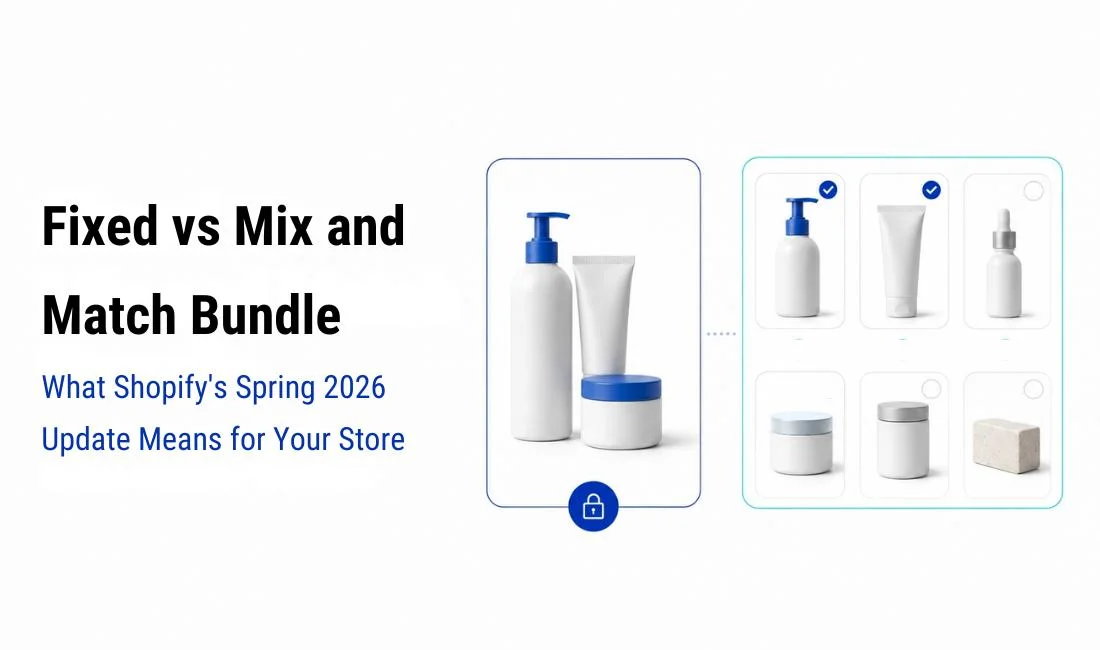
That does not mean every bundle disappears completely. It depends heavily on how your bundle is built. A bundle with its own Shopify Product record is in a very different position from an offer created dynamically through product selection and cart logic.
This article explains that difference, what happens to your bundle discount, and what Shopify merchants can realistically do about it today.
TL;DR
AI shopping agents can discover eligible Shopify products and variants, but UCP does not currently define a first-class bundle, kit, or grouped-product entity.
A fixed bundle that exists as its own Shopify Product record has a path to catalog discovery as a product. That does not mean the agent understands its component relationship as a bundle.
A mix-and-match or build-a-box offer that exists mainly through dynamic selection and cart logic has no equivalent bundle object for an AI agent to discover through UCP.
Bundle pricing can still be calculated at checkout if the qualifying cart reaches the merchant's checkout logic, but the agent does not get the bundle relationship and savings as a catalog offer beforehand.
No bundle app can add bundle awareness to UCP by itself. This is a protocol-level gap.
What UCP's Catalog Capability Actually Tracks
The technical limitation is fairly simple.
Shopify's current Storefront Catalog MCP implements the UCP Catalog capability through three main catalog actions: search_catalog, lookup_catalog, and get_product. Those responses revolve around products and their variants. Agents can retrieve titles, descriptions, prices, availability, options, media, and other supported product data.
There is no standard catalog object for:
A product kit
A bundle component group
A build-a-box configuration
A mix-and-match selection
A set of products that receives a special combined price
That distinction matters.
Imagine that you sell shampoo for $20 and conditioner for $20. Your storefront also offers both together for $34.
An AI agent can potentially find the shampoo product and its variants. It can potentially find the conditioner too. But UCP's current Catalog capability does not provide a standardized bundle record telling the agent that those two products form a $34 merchandising offer.
So when merchants ask whether AI shopping agents Shopify bundles can understand the same way a shopper does on the storefront, the current answer is no, not as a first-class bundle relationship.
The agent sees what the catalog protocol knows how to describe. Right now, that means products and variants.
Why Your Bundle Discount Doesn't Make It to the Agent
This is where the difference between product discovery and checkout becomes important.
A May 2026 UCP bundle-support proposal describes the current gap directly. It notes that UCP's catalog model does not yet contain a bundle entity that can express component groups, bundle selection rules, or an indicative combined saving. The proposal suggests adding that structure in the future.
That does not mean a merchant-side bundle discount can never be calculated.
Suppose your bundle app applies pricing after three qualifying products have been placed into the cart. If an AI-driven shopping flow somehow assembles those exact qualifying items and the merchant's checkout logic runs normally, the server can still calculate the resulting discount.
What is missing happens earlier.
The catalog does not tell the agent:
These three items make one bundle.
The shopper must select one item from each group.
Buying the group together saves 15%.
This configuration is called the "Summer Skin Box."
The bundle has a specific selection limit.
The agent therefore cannot intentionally discover and recommend that offer from a standard UCP bundle record because that record does not exist yet.
This is why "AI agents bundle discounts do not work" is too broad.
A more accurate description is that bundle structure and promotional meaning are not currently represented as first-class UCP catalog data. Checkout logic might still calculate a discount after a qualifying cart exists, but that is different from an agent discovering the bundle offer before checkout.
Does This Depend on How Your Bundle Is Built?
Yes. This is the most important part for Shopify merchants.
Two bundles can look almost identical to a shopper while existing very differently underneath.
When the Bundle Exists as a Shopify Product
Shopify's native fixed bundles are the clearest example.
After a supported Shopify bundle is created, Shopify says the bundle gets a separate product listing in the Products section of the admin. Shopify can identify that parent product as a bundle while tracking its underlying components.
That separate Product record matters because UCP already knows how to retrieve Shopify products.
It does not prove that an AI agent will rank or recommend the bundle. Discovery depends on eligibility, catalog data, query relevance, availability, and the AI channel.
But structurally, there is at least a Product for the catalog to work with.
This is also consistent with Shopify expanding channel support for fixed bundles. Shopify currently allows fixed product bundles to be sold through the Google & YouTube sales channel, along with the Online Store, Shop, and Shopify POS.
You can compare how Shopify treats a fixed or mix-and-match bundle because the difference becomes increasingly important once product discovery moves outside your storefront.
There is still one big limitation.
Even when the parent bundle appears as a Product, current UCP catalog data does not provide the agent with a standardized bundle object explaining the relationship between the parent and all its components.
So the agent may have a product it can discover, but it does not gain first-class UCP bundle awareness.
When the Bundle Exists Through Dynamic Selection and Cart Logic
Now consider a mix-and-match box.
A shopper opens a product page, chooses six flavors from twelve available products, reaches the required quantity, and receives a special bundle price.
The storefront understands the experience because the bundle app controls the selection interface and cart behavior.
But if that exact offer does not exist as its own eligible Shopify Product record, the catalog-reading agent has a different view.
It can work with the eligible products and variants that make up the offer. What it does not receive through UCP is a separate bundle object describing the box, the six-item rule, eligible selections, and the bundle saving.
That is the central issue for AI shopping agents Shopify bundles.
A beautiful storefront bundle experience does not automatically become structured bundle data for an AI agent.
How to Check Your Own Store
You do not need to understand the UCP schema to make the first check.
Go to Products in Shopify admin and look at the bundle offer itself.
Ask:
Does this offer have its own Shopify Product listing?
Does that product have its own title, description, media, price, and publishing settings?
Or does the offer appear only after a shopper starts selecting existing products or variants?
If the bundle interface disappeared, would a standalone bundle product still exist in Shopify?
If there is a real Product record, the offer clears the first structural hurdle for product-level catalog discovery.
If there is no standalone Product record, do not assume the bundle interface itself becomes something an AI catalog agent can search.
AI Shopping Agents Shopify Bundles: What Still Works Right Now
The current limitation does not make your underlying catalog useless.
If the products and variants used in your bundle are published and eligible for the relevant AI channel, agents can still discover them as ordinary products.
That condition matters. A component that is unpublished, unavailable to the relevant channel, hidden, or otherwise ineligible should not be described as automatically visible simply because it belongs to a bundle. Shopify says eligible products are made discoverable through Shopify Catalog and other supported discovery methods.
For AI shopping agents Shopify bundles therefore have two layers.
The first layer is product discovery. Your individual products can still carry useful data such as:
Product titles
Descriptions
Variant options
Prices
Availability
Images
Supported product attributes
The second layer is bundle meaning.
That is where the current gap appears. UCP does not yet standardize the instruction that tells an agent those products should be selected together under a specific bundle offer.
For example, an agent might successfully find four coffee flavors sold by your store.
What it cannot currently get from a first-class UCP bundle entity is: "Choose any four of these eight flavors and pay $35 instead of the normal combined price."
Your products remain useful catalog inventory. The merchandising relationship between them is what gets lost.
Is Bundle Support Coming to UCP?
There is a serious proposal for it, but there is no reason to treat that proposal as a confirmed feature.
The open GitHub discussion proposes adding bundle information across catalog, cart, and checkout. Its suggested model includes concepts for fixed bundles, mix-and-match offers, build-a-box configurations, volume bundles, component groups, selection limits, and indicative savings.
That would solve much of the structural problem described in this article.
An agent could potentially learn that a product represents a bundle, understand what can be selected, communicate the rules to the buyer, and pass the chosen configuration into a compatible shopping flow.
But the proposal is exactly that: a proposal.
It is not evidence that UCP has already adopted bundle support. It is not a Shopify roadmap promise. And there is currently no standard "Bundle Negotiation" capability that merchants should expect an AI shopping agent to use.
For now, merchants should plan around the protocol that exists, not the schema somebody hopes will exist later.
What To Do About It Today
You cannot configure your way around a missing UCP bundle model, but you can make sure the data AI agents already understand is as useful as possible.
Find Out Which Kind of Bundle You Actually Have
Do not classify the bundle only by how it looks to shoppers.
Check whether the offer exists as its own Shopify Product record or depends on existing products plus dynamic selection and cart behavior.
That distinction tells you far more about potential catalog visibility.
Keep Component Product Data Complete
For mix-and-match and build-a-box offers, your component products become especially important.
Use clear titles, accurate descriptions, correct variant names, current pricing, useful images, and accurate availability.
Even when the bundle relationship is missing, strong component data still gives an AI agent something useful to discover.
Do Not Assume Storefront Presentation Becomes Catalog Structure
A bundle can look perfect on your product page and still have no equivalent UCP bundle object.
Storefront UI and catalog structure are separate things.
Test what Shopify Catalog can actually find rather than assuming that anything visible to a human shopper is automatically understandable to an AI agent.
Treat Native or Fixed Bundle Product Records Differently
If your fixed bundle has its own Product record, maintain that product data as carefully as any other listing.
Its existence gives the catalog a concrete product to retrieve. It still does not guarantee that AI agents will understand the internal bundle relationship or rank the product for a particular query.
Keep Expectations Realistic for Bundle Apps
PushBundle can help merchants create mix-and-match, build-a-box, volume, and other bundle experiences on their Shopify storefronts.
It cannot create a UCP bundle capability that the protocol itself does not currently define.
If you use PushBundle, keep the products behind your bundle clean and well structured, and understand whether your particular offer creates a standalone Shopify Product record or relies mainly on dynamic selection and cart behavior. It gives you a much more realistic picture of how the offer can appear outside your storefront.
FAQ
Can I Opt Out of Agentic Storefronts if I Don't Want AI Agents Recommending My Bundle Items Separately?
Will an AI Agent Apply My Bundle Discount if It Checks Out on a Shopper's Behalf?
Does Shopify's Native Bundles App Show Up Better to AI Agents Than Third-Party Bundle Apps?
Why Might My UCP Setup Look Correct but Still Not Surface My Bundle Properly?
Is Shopify or UCP Actively Working on Bundle Support for AI Agents?
Conclusion
AI shopping agents Shopify bundles are not a simple yes-or-no problem.
A fixed or native bundle that exists as its own Shopify Product has a structural path into product-level catalog discovery. That does not mean UCP understands the bundle's internal components as a bundle.
A mix-and-match or build-a-box offer that exists mainly through dynamic selection and cart logic faces a bigger visibility gap. Eligible component products can still be discoverable, but UCP does not currently provide a standard object that explains why those products belong together, which selections qualify, or what saving the shopper gets.
And that is the important distinction.
This is not something PushBundle, another bundle app, or a merchant setting can fully solve today. The missing piece sits in the protocol itself.
If UCP eventually adopts first-class bundle support, AI shopping agents Shopify bundles could become much easier to discover, configure, and recommend as complete offers. Until then, merchants should know exactly how their bundles are represented in Shopify and make the product data that agents can already read as accurate as possible.
Reviewed for accuracy
This article was reviewed by the PushBundle Technical Support Team, who regularly helps Shopify merchants test bundle setup, product selection rules, bundle pricing, cart behavior, and checkout-related bundle issues.
About the author

Syeda Rehnoma Tanzom
PushBundle Contributor
This article is written by Syeda Rehnoma Tanzom, an SEO content writer with 3+ years of experience specializing in eCommerce content. What makes the work here a little different? A close collaboration with support teams to understand what merchants are actually going through, their frustrations, their questions, and their wins. The goal is simple: write content that speaks to real problems, not just search engines. When not buried in keywords and content briefs, you'll find her nose-deep in a good book, binge-watching true crime documentaries or psychological thrillers, and occasionally switching gears with a feel-good rom-com.