Last year, we mapped out what product bundling trends 2025 would look like and we got some of it right.
AI-powered bundle recommendations? That landed. Subscription bundles as a recurring revenue play? Merchants ran with it. Sustainability framing around consolidated shipping? It’s quietly becoming a real selling point for eco-conscious buyers.
But some of our predictions didn’t pan out. Blockchain-verified bundles never made it past theory for most Shopify merchants. Voice commerce bundling is still not a practical reality for the average store. AR-powered bundle previews? Niche at best.
So this year, we’re skipping the speculation. This is a breakdown of the product bundling trends 2026 that are actually showing up in merchant behavior right now; not what sounds exciting in a blog post.
If you want to see where we started, here’s what we predicted last year.
Table des matières
Product Bundling Trends 2026: Overview
| Product Bundling Trends 2026 | What It Solves | Best For | Effort |
|---|---|---|---|
| Bundles as Value Architecture | Discount fatigue, margin erosion | All store types | Faible |
| Moment-Based Bundle Framing | Poor bundle conversion, generic naming | All store types | Faible |
| Starter Kit Bundles | New customer overwhelm, AI search visibility | Stores with a learning curve (fitness, skincare, pet, craft) | Faible |
| AI-Powered Dynamic Bundles | Static offers that don’t convert | Scaling stores with purchase history data | Haut |
| “Try Once, Then Subscribe” | Cold subscription resistance, high churn | Consumables — supplements, skincare, food, coffee | Medium |
| Post-Purchase Bundle Upsells | Missed revenue after checkout | All store types | Medium |
| B2B & Wholesale Bundle Packs | Wholesale ordering friction, reorder inconsistency | Stores with both retail and wholesale accounts | Medium |
| Inventory-Clearing Bundles | Dead stock, clearance perception | Stores with slow-moving SKUs | Faible |
| Bundle Performance Tracking | Set-it-and-forget-it bundling, invisible margin loss | Stores already running bundles | Faible |
Trend#1 Bundles Aren’t About Discounts Anymore
This is the biggest mindset shift driving product bundling trends 2026. And it’s reshaping how smart merchants think about their entire bundling strategy.
For years, bundles meant one thing. Slap a “save 20%” badge on a product group and call it a day. That still works sometimes, but it’s losing ground fast.
Discount fatigue is real. Customers have been trained to wait for sales, ignore percentage-off badges, and compare bundle prices against individual items before they buy. When every store runs bundle deals, none of them feel special anymore. The badge becomes noise.
The merchants pulling ahead in 2026 are repositioning bundles as curated, high-value experiences, not discounts with extra steps. Rhode Skin is the clearest example of this. Their bundle revenue grew from $948K to $2.53M per month, not by running steeper discounts, but by selling kits as lifestyle upgrades. The bundle is the product. The value is in the curation, the naming, and the experience, not the percentage saved.
This is what’s called a value architecture. Instead of “buy these three things and save 15%,” the message becomes “this is everything you need for X.” The price feels justified. The margin holds. And the customer feels like you’ve done the thinking for them, which is exactly what drives repeat purchases.
The practical implication is straightforward. Audit your current bundles. If every single one leads with a discount message, you’re leaving margin on the table and training customers to expect markdowns. Try reframing one bundle around the outcome it delivers and see how conversion changes over 30 days.
Trend#2 Moment-Based Bundle Framing
This one is subtle. And it’s one of the product bundling trends 2026 that any merchant can act on without changing a single product or touching their pricing.
Most bundles are named after what’s in them. “Skincare Bundle.” “Coffee Set.” “Home Office Pack.” That’s descriptive; but it doesn’t do much selling on its own. The shift happening now is merchants naming and building bundles around a moment or use case instead of a product category. Not “skincare bundle”, “Your Sunday Reset Routine.” Not “coffee bundle”, “Your First Brew Setup.” Not “gym gear”, “Your First Week Back.”
The difference isn’t just cosmetic. When you name a bundle after a moment, you’re answering the customer’s real question before they even ask it. They’re not shopping for products. They’re shopping for an outcome. A bundle named after a moment makes that outcome obvious before they read a single word of the description.
It also changes who the bundle appeals to. “Skincare Bundle” is for anyone who buys skincare. “Your Sunday Reset Routine” is for a specific person with a specific habit and that person feels like it was made for them. That feeling of recognition is what converts browsers into buyers.
This framing works particularly well for three situations: gift purchases where the buyer needs clarity fast, new customer acquisition where you want to reduce overwhelm, and seasonal campaigns where the moment is already top of mind. The work is mostly in the naming and the copy, not the products themselves.
Trend#3 Starter Kit Bundles Are Winning in AI Search
Here’s something most merchants haven’t caught onto yet and it’s creating a real gap between stores that are picking up organic discovery and those that aren’t.
When someone types “what do I need to get started with X” into Google, Perplexity, or ChatGPT Search, AI-generated answers are increasingly surfacing starter kit bundles directly in their responses. Not individual products, not category pages, bundles that are clearly positioned as a complete first-purchase solution for a specific type of buyer.
That’s a meaningful shift in how discovery works. A well-named, well-described starter kit bundle doesn’t just convert better on your product page. It can now appear in AI-generated search answers, driving top-of-funnel traffic that didn’t exist two years ago.
But fixed kits have one weak spot. A customer loves the bundle but the resistance bands aren’t in their color or the gloves aren’t their size. That friction kills the sale.
With PushBundle, you can let customers pick their color and size for each item in the kit, without breaking the bundle experience. They still buy the complete set, just on their terms. You can put min/max restrictions on options, variants, and products. This is what your customers will see on the product page.
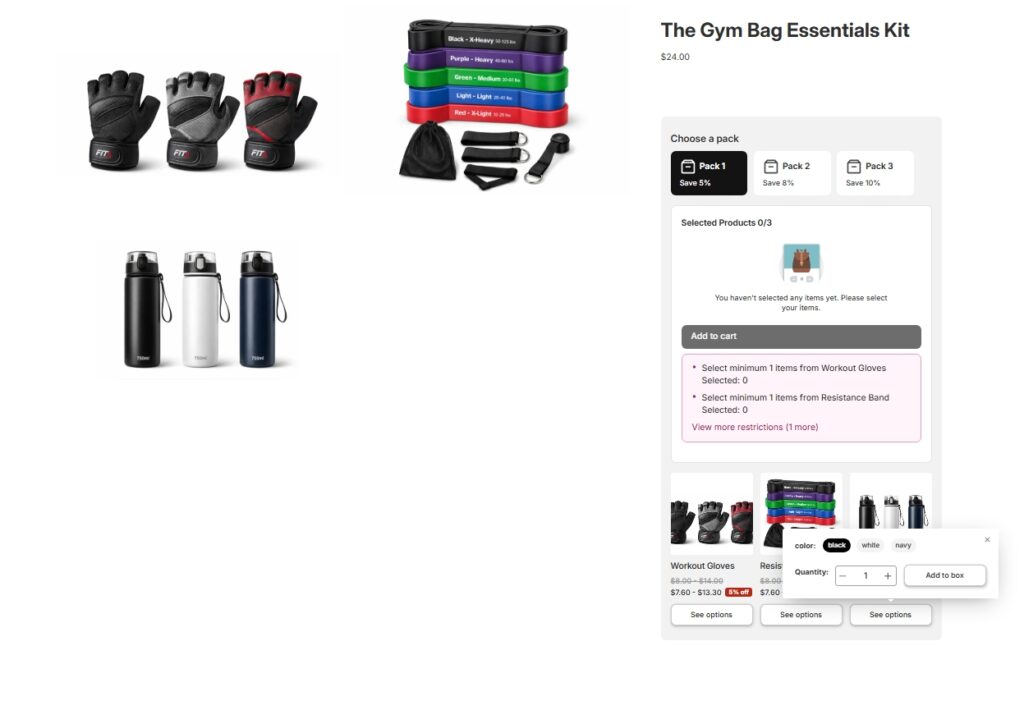
They also generate better first-party data. When someone buys “The New Runner Starter Kit,” you know exactly where they are in their journey and you can build the follow-up marketing around that.
Trend#4 What Are AI-Powered Dynamic Bundles?
Static “frequently bought together” widgets aren’t doing the job they used to. And in 2026, that gap is getting harder to ignore as one of the clearest product bundling trends 2026 merchants are navigating.
In 2025, we flagged AI-powered bundling as an incoming trend. In 2026, it’s no longer incoming.
Selon Capgemini research, 71% of consumers want generative AI integrated into their shopping experiences. A static bundle built on the average behavior of all your customers doesn’t meet that expectation for any individual and increasingly, they notice.
Dynamic bundles respond to the individual. They look at what a specific customer has browsed, what they’ve bought before, what similar customers ended up purchasing, and surface a bundle that’s actually relevant to that person.
For a skincare store, this might mean showing a combination of products based on skin concern signals from a customer’s browsing behavior. Someone reading about dry skin gets a different bundle recommendation than someone reading about acne. For a food store, it might mean a bundle built around a dietary preference the customer has shown through past purchases.
If you’re still running the same manually-set bundle combinations you built six months ago with no personalization layer, this is worth putting on the roadmap.
Trend#5 The “Try Once, Then Subscribe” Bundle Model
Subscription fatigue is a real and growing problem for merchants selling recurring products in 2026.
Customers are increasingly reluctant to commit to a subscription before they’ve experienced the product. The cold subscription offer, “sign up for monthly delivery” on a first visit from a new customer, converts poorly for most stores outside of very established brands. People don’t want to feel locked in before they know what they’re getting.
The try-once-then-subscribe model removes that barrier entirely. A customer buys a one-time bundle, a 30-day starter pack, a sample kit, a trial set, and after receiving and using it, they get a well-timed follow-up: loved it? get it monthly and save.
That sequence converts significantly better than leading with the subscription ask upfront. The customer has already experienced the product. The value is no longer theoretical. The commitment feels much smaller because they know exactly what they’re signing up for. And the merchant is capturing recurring revenue from buyers who are genuinely satisfied, which means lower churn and higher lifetime value downstream.
The timing of the follow-up matters enormously. Too early and it feels like a cash grab. Too late and the momentum is gone. Based on what we’ve observed, the sweet spot tends to be 7-14 days after delivery, when the product has been used but hasn’t run out yet.
Trend#6 The Thank You Page Is the Most Wasted Real Estate in Ecommerce
The thank you page, the confirmation screen right after a customer completes checkout, is the highest purchase-intent moment in the entire buying journey. The customer just said yes. Their card is already charged. They don’t have to re-enter payment details. They’re still in a buying mindset.
And most Shopify stores put nothing useful there.
A candle store showing “complete the set”, three complementary scents at a one-click price, right after a customer buys their first candle. A coffee store offering the full brewing kit to someone who just bought their first bag of beans. A skincare store surfacing a bundle of the products that work best alongside what was just purchased.
One click, no re-entering anything, no new checkout friction. Just “do you want this too?”
The conversion rates on well-executed thank you page bundle offers consistently outperform cart upsells and email follow-ups. Because the timing is better, the intent is higher, and the customer is already in a yes-state. Cart upsells interrupt a decision in progress. Thank you page offers arrive after the decision is made, which is a completely different psychological moment.
Trend#7 B2B and Wholesale Bundle Packs
B2B bundling was on the radar in 2025. Now, it’s one of the most underrated product bundling trends 2026 for Shopify merchants running wholesale accounts alongside their retail operations.
The core problem is friction. Wholesale buyers want volume, but they don’t want to spend time configuring orders from scratch every time they reorder. They want predictability. They want to place a quick, structured order and get back to running their business. A pre-configured bundle pack built specifically for wholesale buyers, “Café Starter Pack: 10 units each of our 3 bestsellers, priced for resale margins”, answers that need directly.
It also removes the back-and-forth that slows down B2B sales cycles. The buyer doesn’t need to negotiate a custom quote. The merchant doesn’t need to manually price every order. The bundle is the offer; transparent, consistent, and ready to reorder.
Beyond convenience, wholesale bundle packs create a natural pricing separation between retail and B2B without needing two separate stores or complex discount logic. The retail customer sees one set of products and prices. The wholesale buyer sees a different bundle structure built for their context. Both feel like the offer was designed for them, because it was.
For merchants in food, cosmetics, apparel, or any category where retail buyers and wholesale accounts coexist, B2B bundle packs are one of the cleaner ways to serve both audiences without operational headaches.
Trend#8 Clearing Dead Stock Without Looking Like You’re Clearing Dead Stock
Every merchant has slow-moving inventory. The standard response is a discount, either on the product itself, or bundled with something popular in a way that practically signals “we need to move this.” Customers notice. And once they do, it changes how they see your brand.
A desperation bundle is easy to spot. The pairing doesn’t quite make sense. The discount on one item is unusually steep. The product has been sitting on the homepage for weeks. Experienced shoppers figure it out quickly — and it erodes trust in your curation.
The trend in 2026 is doing this invisibly. Pairing slow stock with bestsellers but building and naming the bundle entirely around a use case, with no signals that anything is being cleared.
A kitchenware store pairing a slow-selling spice rack with a bestselling knife set as “The Complete Prep Station.” No mention of stock. No aggressive discount on the spice rack specifically. Just a bundle that makes logical, useful sense together and happens to move a product that needed moving.
The slow-moving item gets exposure alongside something customers already trust and want. The bestseller makes the whole bundle feel intentional and curated. The merchant moves inventory without training customers to wait for clearance events or expect markdowns on specific products.
The key is the framing. If the bundle name or description gives any hint that one item is the “bonus” or the “extra,” the effect is lost. It needs to feel like both products belong together equally, because the use case genuinely requires both.
Trend#9 Tracking Bundle Performance Like a Managed Revenue Channel
This is the least glamorous trend on the list. It’s also the one that separates merchants who are genuinely scaling with bundles from those who are just running them and hoping for the best.
Most merchants set up a bundle, watch it passively for a week or two, and then move on. It either sells or it doesn’t. There’s rarely a structured review of why a bundle performs or underperforms – which product pairing drove the conversion, which price point held, which combination quietly ate margins even when it sold.
What’s changing is that merchants are now treating product bundling trends 2026 the way they treat paid ad campaigns. Monthly performance reviews. Clear metrics tracked consistently. A real willingness to kill underperformers fast instead of letting them run indefinitely out of inertia.
The metrics worth tracking are straightforward: bundle conversion rate, AOV lift compared to single-product purchases, margin per bundle sold, and which individual products within a bundle get abandoned at checkout. That last one is particularly telling; if customers are consistently removing one item from a 3-product bundle before completing the purchase, that item doesn’t belong in the bundle.
A merchant who notices their 3-product bundle converts at 18% while their 5-product bundle converts at 6% and immediately simplifies the offer, is making a data-driven decision that most competitors aren’t. The data is available in Shopify Analytics for most of these metrics. The difference is whether you’re actually looking at it monthly and acting on what you find.
Bundling is becoming a managed revenue channel in 2026, not a set-it-and-forget-it tactic. The stores treating it that way are pulling ahead.
Quick Implementation Priority for Your Shopify Store (April–June 2026 Rollout)
Not all product bundling trends 2026 belongs on your plate right now. Where you start depends entirely on where you are.
Stage#1 You’re just getting started with bundles
You’ve either not run bundles before or you’ve set up one or two basic offers without a real strategy behind them. Don’t try to do everything at once.
Commencer par Moment-Based Bundle Framing. Rename your existing products or create one new bundle built around a specific use case. No new app needed. Just better naming and copy.
Then move to Starter Kit Bundles. Identify your most common first purchase and build a complete starter offer around it. These two moves cost almost nothing and give you a foundation to build on before you touch anything more complex.
Stage#2 You’re bundling but not seeing real results
Your bundles exist, some are selling, but AOV hasn’t moved meaningfully. The problem is usually one of three things: weak framing, wrong product pairings, or no post-purchase strategy.
Fix the framing first using Moment-Based Bundle Framing if you haven’t already. Then activate Thank You Page Bundle Upsells. This is the fastest AOV lever available to a merchant who’s already getting orders. Finally, look at your data using the Bundle Performance Tracking approach. You probably have at least one underperforming bundle that’s diluting your results without you realizing it.
Stage#3 Bundling is working and you’re ready to scale
Your bundles are converting, AOV is up, and you want to go deeper. This is where the more sophisticated product bundling trends 2026 pay off.
Layer in AI-Powered Dynamic Bundles to move beyond one-size-fits-all offers. Build out the “Try Once, Then Subscribe” model if you sell consumables. This is your clearest path to predictable recurring revenue. And if you have wholesale accounts, build dedicated B2B Bundle Packs to reduce ordering friction and increase reorder frequency. Run the Bundle Performance Tracking discipline monthly without exception.
Product Bundling Trends in 2027: What’s Coming Next
We’ll keep this section honest — these aren’t wishes. They’re early signals already visible in merchant behavior in 2026 that we expect to become mainstream by next year.
Bundle-first product development. Some merchants are already designing products specifically to be sold as part of a bundle — not as standalone SKUs that happen to get grouped together later. The bundle is the primary product. The individual items are secondary. This is a significant mental shift and it’s showing up most clearly in beauty, supplements, and food. By 2027, expect more Shopify merchants to build their product catalog around bundle-native SKUs from the start.
Personalized bundle pricing. Different customers seeing different bundle prices based on purchase history, loyalty tier, or customer segment. This already exists at enterprise level. Apps are starting to bring it within reach of mid-market Shopify merchants. By 2027, a returning customer who’s bought three times should see a different bundle price than a first-time visitor.
Bundles as a retention tool, not just an acquisition play. Right now, most bundle strategy is focused on the first order, increase AOV, move more units, convert the new customer. The next wave is post-purchase bundle flows built specifically to bring customers back. Not email discounts. Not loyalty points. Bundles that are timed and personalized based on when a previous bundle should be running out, a “time to restock” bundle offer that arrives exactly when the customer needs it.
We’ll revisit these in the 2027 edition and be just as honest about which ones landed.
Product Bundling Trends 2026 Are About Being Smarter, Not Louder
The merchants winning with product bundling trends 2026 aren’t running more bundles. They’re running better ones.
Better names. Better timing. Better data. Better framing. Less “here’s a discount,” more “here’s exactly what you need and when you need it.”
The fundamentals haven’t changed; bundles still increase AOV, move inventory, and reduce decision fatigue. But the execution gap between merchants who treat bundling as a random tactic and those who treat it as a managed channel is getting wider every month.
Pick one trend from this list that matches where you are right now. Test it for 30 days. Let the data tell you what to do next.
Product Bundling Trends 2026: FAQs
How much of a discount should I offer on a bundle?
It depends on your margins. If your margins are 50% or higher, 10–20% off works well. If margins are tighter — under 50% — stick to 5–10%. Going deeper than 25% trains customers to distrust your individual product prices.
Do I need to discount my bundles at all?
No. Some of the best-performing bundles carry no discount at all. Customers pay for convenience and curation — not just savings. If your bundle solves a clear problem or saves the customer from multiple shopping steps, the value is there without a price cut.
How many bundles should I start with?
One. Start with your bestseller paired with one or two products customers naturally buy alongside it. A single well-executed bundle tells you more about your customers’ bundling appetite than launching five at once.
Which product bundling trend in 2026 should I start with if I’m new to bundling?
Start with Moment-Based Bundle Framing. It costs nothing to implement — no new app, no pricing changes. Just rename your existing bundle around a use case or moment instead of a product category. It’s the lowest effort, highest immediate impact change on this list.
Which of these product bundling trends 2026 is most likely to directly increase my AOV?
Post-Purchase Bundle Upsells. It targets the highest purchase-intent moment in the entire buying journey — right after checkout, when the customer is already in a yes-state. No extra traffic needed. No new product development. Just a well-placed offer at the right moment. Merchants already getting consistent orders will feel this one fastest.

Blogs en vedette articles
juillet 23, 2026
How to Combine Product Bundles, Cart Upsells, and Free Shipping Goals to Increase Shopify Revenue
9 juillet 2026
Pack fixe vs pack modulable : ce que la mise à jour de printemps 2026 de Shopify signifie pour votre boutique

30 juin 2026
PushBundle vs Bundler : Quelle application de regroupement Shopify vaut le coup en 2026 ?
29 juin 2026

 Français
  English
  日本語
日本語  Deutsch
  Español
  简体中文
简体中文  Italiano