The best cross-sell apps on Shopify help merchants earn more from the traffic they already paid for. According to Baymard Institute’s meta-analysis of 49 independent studies, the average cart abandonment rate is 70.19%, meaning roughly seven out of ten shoppers leave without buying. The last thing a store needs is a cross-sell widget that distracts shoppers instead of helping them choose.
Most stores still use generic “related products” blocks that connect a running shoe to a random hoodie with no clear reason for the pairing. That is not helpful cross-selling. It is just clutter. The stores that raise AOV consistently do so with cross-sell offers that feel like a helpful next step, not an afterthought tacked onto the product page.
- Cross-selling helps Shopify stores increase AOV from existing traffic.
- The best offers feel helpful, not random or distracting.
- PushBundle is best for structured cross-sell bundle offers.
- Other apps work better for cart, checkout, or post-purchase offers.
- Start with one strong pairing, test results, then expand.
Table des matières
What Is Cross-Selling on Shopify?
Cross-selling means recommending a complementary product that makes the original purchase better. The best cross-sell apps on Shopify help merchants place that recommendation at the exact moment the customer is most likely to understand its value.
Here is the fastest way to separate the three strategies that often get confused:
- Cross-selling: A shopper buying running shoes is shown running socks. Complementary and relevant.
- Upselling: A shopper choosing the 64GB model is shown the 128GB version. Same product, higher tier.
- Bundling: A shopper gets a camera, strap, memory card, and bag grouped into one pre-curated offer.
This Shopify cross-sell vs upsell app distinction matters because many apps use these terms loosely. A merchant who thinks they are cross-selling may actually be pushing upsells, and the wrong strategy in the wrong placement can hurt conversion rate rather than help it.
What Should Merchants Check Before Choosing an App?
The best cross-sell apps on Shopify should increase AOV without turning the product page into an offer wall. Before installing anything, check these key criteria:
- Does the app support product page placements?
- Does it support cart drawer placements?
- Does it support post-purchase placements?
- Can you set manual pairing rules?
- Can you exclude weak product matches?
- Can you track clicks, add-ons, and revenue per offer?
- Does pricing scale by orders, clicks, or revenue generated?
- Does it work with your theme and cart drawer setup?
A frequently bought together app Shopify merchants trust should let them control pairings manually or with behavior data. Manual rules are often safer for curated brands. A Shopify app to suggest related products should also let you exclude poor matches. Nobody wants winter gloves attached to a summer sandal listing.
One solid cross-sell offer in the right placement consistently outperforms five generic widgets scattered across the store. That is the point most merchants miss when they start installing cross-sell apps.
Best Cross-Sell Apps on Shopify
The best cross-sell apps on Shopify match the stage in the buying journey where your shopper is most receptive. Product page suggestions, cart add-ons, and post-purchase offers each solve a different problem.
Quick Comparison Table
| App | Rating | Reviews | Developer | Tarification |
| PushBundle | 4.9 | 16 | QuandLab FZC | Free plan available. Paid plans start from $14/month. |
| ReConvert | 4.8 | 2,800+ | Upsell.com ex ReConvert | Free plan available. Paid plans start from $4.99/month. |
| Essential Upsell and Cross Sell | 5.0 | 2,100+ | Essential Bundles & Upsells | Free plan available. Paid plans start from $9.99/month. |
| Echo Checkout Widget and Bundle | 4.4 | 5 | CodeInspire.io | Free to install. Paid plans start from $14/month. |
| Llama: Cart, Gifts, Discounts | 5.0 | 14 | Llama Commerce LLC | Free plan available. Paid plans start from $9.99/month. |
Note: App ratings, review counts, pricing, and feature names can change. Check each Shopify App Store listing before installing.
1. PushBundle – Best for Cross-Sell Bundles
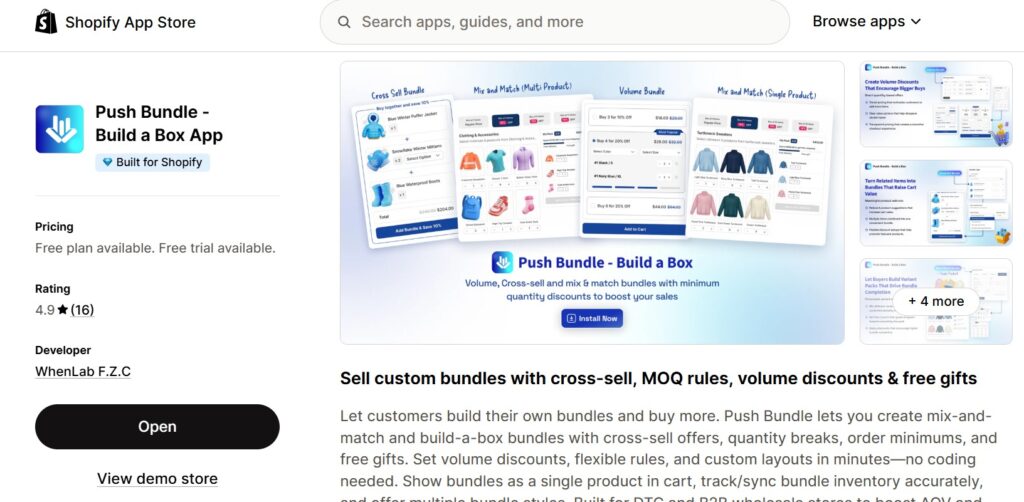
PushBundle is the strongest first pick when cross-selling needs structure. Customers can easily ignore a single-product widget. A cross-sell bundle that helps them build a useful set is harder to ignore because the offer feels more complete.
PushBundle turns cross-sell ideas into controlled bundle offers. The customer sees the pairing in context, understands why the products belong together, and can complete the bundle in a few clicks. It also carries the Built for Shopify badge, meaning it has been tested to meet Shopify’s highest performance and integration standards.
Best for: Cross-sell bundles; frequently bought together offers; ensembles personnalisés; mix and match product packs; related product bundles; stores that want one app for bundles and cross-sells
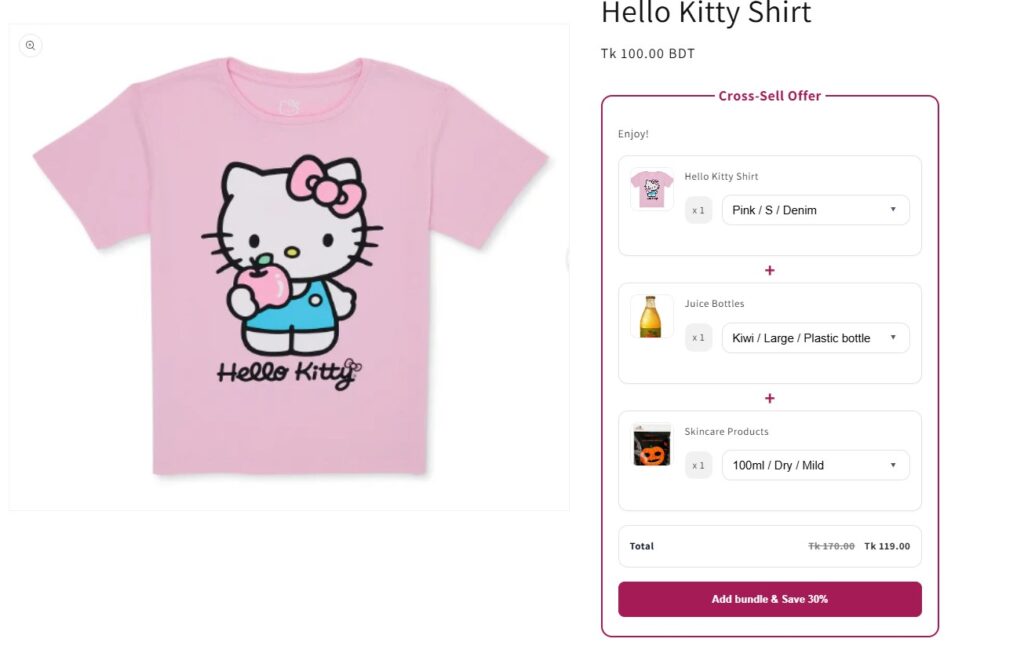
Cross-Sell Offer with PushBundle: Customers can select different variants from each product to create custom cross-sell bundles.
Key features:
- Cross-sell bundles and frequently bought together offers
- Mix and match product selection with variant support
- Build a box bundles and related product offers
- Volume discounts and custom quantity packs
- Custom layouts and variant-based bundle rules
App details:
| Field | Details |
| Best fit | Stores that want cross-sell offers structured as bundles, where the complementary product sits next to the main product with a clear discount and one-click add-to-cart |
| Strongest use case | Cross-sell bundles that pair related products together with fixed or percentage discounts, so the complementary product feels like a natural part of the purchase rather than an afterthought. |
| Main limitation | Mix and match rules, advanced eligibility controls, and cross-sell bundle layouts are available on paid plans |
A cross-sell bundle app Shopify merchant can use PushBundle to recommend a belt with jeans, socks with shoes, or travel-size minis with full-size skincare. The offer becomes more than a product suggestion. It becomes a useful set the shopper can complete on the same page.
To increase the AOV of Shopify cross-sell campaigns, that structure matters. The offer should feel like help, not pressure. Customers are more likely to add another product when the offer feels helpful, not forced.
2. ReConvert – Best for Post-Purchase Offers
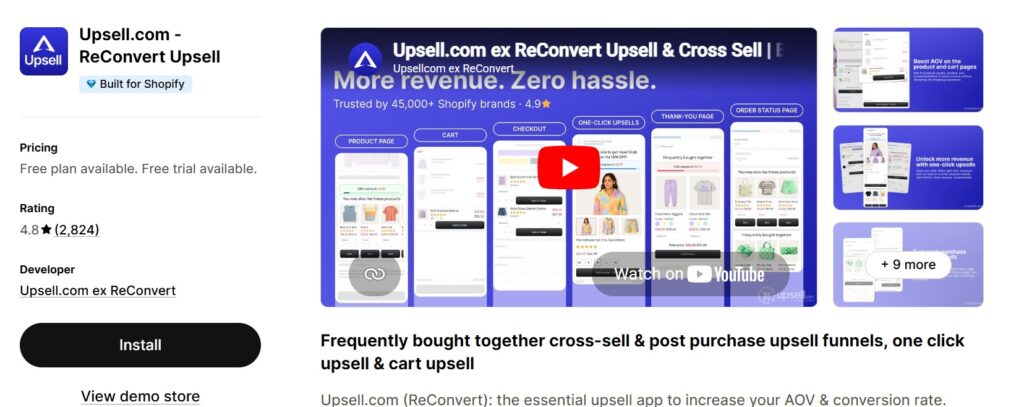
ReConvert is built for the moments after the shopper has already committed. Cart page, checkout, thank you page, and post-purchase offers all work well here, especially for products that do not require much explanation before adding.
Best for: Post-purchase offers; thank you page add-ons; checkout upsells; refill offers; warranties; simple repeat-purchase prompts
Key features:
- Post-purchase and thank you page offers
- Checkout upsells and cart page placements
- Funnels and analytics with multiple offer placements
App details:
| Field | Details |
| Best fit | Stores focused on post-purchase revenue that want to cross-sell simple add-ons after the order has already been placed |
| Strongest use case | One-click cross-sell offers shown on the thank you page, where buying resistance is low and the shopper has already committed |
| Main limitation | Pricing scales with monthly order volume, so costs rise as the store grows and can become expensive for high-volume merchants |
A skincare store can offer a refill after checkout. A camera store can offer a memory card after purchase. That timing works because the customer has already committed. Do not use post-purchase offers for products that require long comparison. Use them for obvious, low-risk add-ons only.
3. Essential Upsell and Cross Sell – Best for Simple Add-Ons
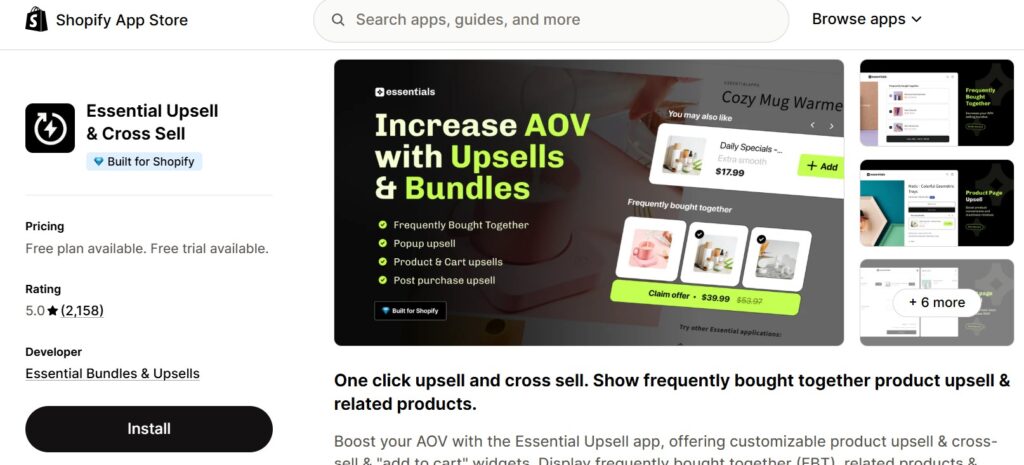
Essential Upsell and Cross Sell works well when merchants want straightforward product pages and cart offers without building complex bundles. It is a practical starting point for stores testing related product recommendations for the first time.
Best for: Simple product page add-ons; frequently bought together widgets; cart offers; basic post-purchase prompts
Key features:
- Product page and cart upsells
- Frequently bought together offers and campaign rules
- Post-purchase add-ons and customizable display options
App details:
| Field | Details |
| Best fit | Stores testing cross-sell placements for the first time and looking for a no-code setup on product pages and cart drawer |
| Strongest use case | Frequently bought together widgets on product pages that surface complementary products with automatic discount promotions |
| Main limitation | Free plan caps upsell revenue at $100 per month, which limits meaningful testing on stores with active traffic |
A cookware brand might recommend a lid for a pan. A gym brand might recommend resistance bands with a workout mat. These offers do not need a complicated funnel. They just need strong pairing logic and clean placement.
4. Echo Checkout Widget and Bundle – Best for Checkout-Focused Offers
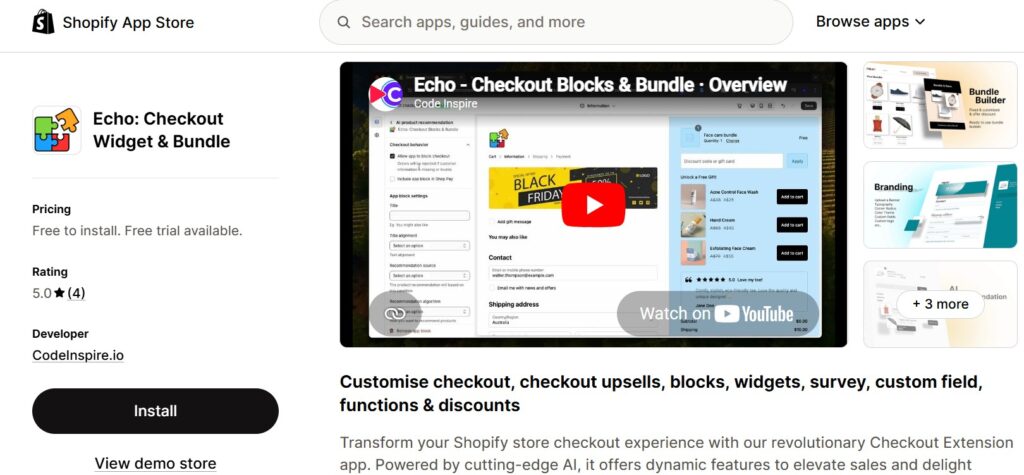
Echo Checkout Widget and Bundle has relatively fewer reviews than the rest of the apps here. Nonetheless, it has achieved a 5-star rating through its excellent service. The app is focused on the checkout experience. It fits merchants who want to place offers as close to the payment step as possible, where buying intent is at its peak.
Best for: Checkout offers; post-purchase prompts; survey widgets; free-gift-style campaigns; merchants with strong product pages already in place
Key features:
- Checkout widgets and bundle builder
- Volume discounts and free gift offers
- Post-purchase support and survey widgets
App details:
| Field | Details |
| Best fit | Stores that want cross-sell offers placed at checkout, as close to the payment step as possible |
| Strongest use case | Checkout widgets that surface bundle offers and free gift prompts at the moment buying intent is highest |
| Main limitation | Very small review base makes it harder to evaluate reliability at scale compared to more established apps |
This app fits merchants whose product pages are already doing the heavy lifting. If customers arrive at checkout ready to buy, that moment becomes the next logical place to test AOV improvement. It is not the right starting point if the product page still has conversion problems that need fixing first.
5. Llama – Best for Cart Drawer Offers
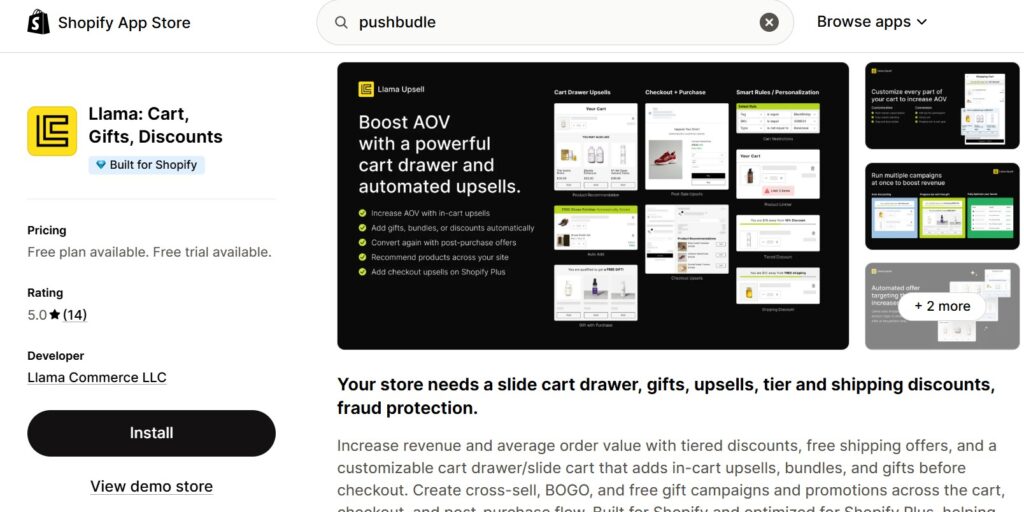
Llama: Cart, Gift, Discounts fits merchants who want to influence the cart moment specifically. Cart drawer offers work best when the recommended product is small, relevant, and easy to add with zero friction.
Best for: Cart drawer upsells; free gift prompts; small add-ons after buying intent is shown; offer progress bars
Key features:
- Cart drawer offers and free gift prompts
- Upsell campaigns and cart-based recommendations
- Offer progress prompts and storefront display options
App details:
| Field | Details |
| Best fit | Stores that want to cross-sell small, relevant add-ons inside the cart drawer before the shopper reaches checkout |
| Strongest use case | Auto-triggered free gift and BOGO campaigns inside the cart that activate when a shopper’s cart value crosses a set threshold |
| Main limitation | Cart drawer-focused setup adds less value for stores where customers bypass the cart and go directly to checkout |
A protein brand can offer a shaker bottle inside the cart. A stationery brand can offer a pen refill. These offers work because the shopper has already shown buying intent. The add-on just needs to be obvious and easy to accept.
Where Should Cross-Sell Offers Appear?
Cross-sell placements work when they match shopper intent at that specific moment in the journey. The best Shopify cross-sell apps 2026 support multiple placements, but that does not mean every store should use every placement at once.
Product page: Use when the shopper still needs information about the complementary product. A jeans shopper may need to see the belt material, size, and color before adding it.
Cart drawer: Use when the add-on is small and obviously useful. A shopper buying protein powder may add a shaker bottle with one tap before checkout.
Post-purchase: Use when the add-on makes complete sense after the order is placed. A camera buyer may add a memory card after checkout without needing to return and browse again.
Post-purchase upsell apps work because the shopper has already committed. The barrier to saying yes to one more item is lower than it was before checkout. That said, post-purchase offers only work for products that do not need comparison. If the add-on requires thought, place it earlier in the journey where the shopper still has time.
How to Test a Cross-Sell Campaign
Start with one product category and one obvious complementary product. Test socks with shoes, belts with jeans, refill packs with skincare, or a memory card with a camera. Pick one pairing. Pick one placement. Run that test properly before adding anything else.
Here is a clean testing process:
- Pick one main product category with strong existing traffic
- Choose one complementary product that makes the pairing immediately obvious
- Place the offer in one location only for the test period
- Track clicks and add-on rate for at least two weeks
- Compare AOV before and after the campaign period
- Check whether the overall conversion rate holds steady or drops
- Adjust the offer if shoppers are consistently ignoring it
- Expand to a second pairing or placement only after the first works
This keeps cross-selling useful and protects the customer experience from becoming cluttered. A Shopify cross-sell app free plan is a good starting point for testing without financial risk. Run the test, measure the result, then decide whether to invest in a paid plan based on real data.
FAQ
What is the difference between a cross-sell app and an upsell app?
A cross-sell app recommends a complementary product. An upsell app recommends a higher-priced or upgraded version of the same product. Many apps include both strategies, but the placement and pairing logic should reflect which approach you are actually running.
Can I cross-sell without paying a percentage of revenue?
Yes. Many apps use free plans or flat monthly pricing. Always check the billing screen carefully because some plans scale by orders, clicks, or revenue generated. The billing modal is the most accurate source, not the app listing page.
Where should cross-sell offers appear first?
Start with the product page for discovery-stage shoppers or the cart drawer for small, obvious add-ons. Use post-purchase offers only when the extra product does not require comparison or explanation to make sense.
Do cross-sell apps slow down Shopify stores?
They can if several apps add scripts to the same pages simultaneously. Use one focused app when possible and test mobile page speed after setup. A slow product page hurts conversion more than any cross-sell offer can fix.
Can cross-sell bundles work alongside discount apps?
Yes, but compatibility should be tested on your specific store setup. Cross-sell bundles can overlap with discount rules, cart scripts, subscription products, and checkout logic. Testing in a development environment first is always worth the time.
Is frequently bought together the same as cross-selling?
It is one type of cross-selling. Cross-selling also includes cart add-ons, manual product recommendations, bundle-based offers, and post-purchase promotions. Frequently bought together is the most common starting point because the pairing logic is already built around real purchase behavior.
Conclusion
The best cross-sell apps on Shopify make the next product feel like a useful suggestion, not a sales tactic. PushBundle fits cross-sell campaigns that benefit from bundle structure, while post-purchase tools work best for obvious add-ons that need no explanation after checkout.
Do not start with five offers running simultaneously across every page. Pick one product category, identify one relevant complementary product, measure the result carefully, and only expand when the first offer is working. And remember: app ratings, review counts, pricing, and feature names can change. Check each Shopify App Store listing before installing.

Blogs en vedette articles

18 juin 2026
Limitations des offres groupées natives de Shopify : Explications sur les options Mix and Match, BOGO et Build-a-Box
16 juin 2026
Meilleures applications Shopify pour générer du volume de ventes en 2026 (B2B et vente en gros)
4 juin 2026
 Français
  English
  日本語
日本語  Deutsch
  Español
  简体中文
简体中文  Italiano