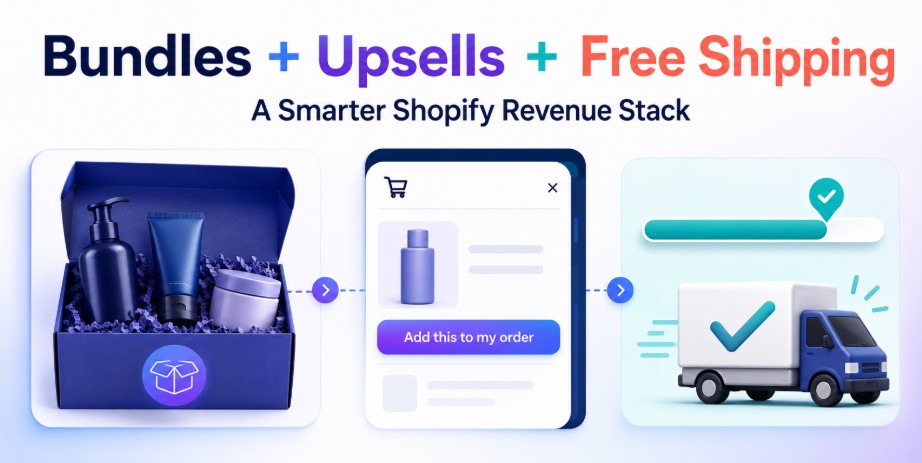
A practical framework for raising average order value without turning the cart into a wall of offers
Most Shopify stores treat product bundles, cart upsells, and free shipping as separate tactics. A bundle appears on the product page. An upsell appears in the cart. A shipping banner sits somewhere above both. Each may help on its own, but the bigger opportunity comes from coordinating them around one purchase decision.
The logic is simple: a bundle gives shoppers a compelling way to buy more, a cart upsell suggests the most relevant next item, and a free-shipping goal gives the shopper a visible reason to complete the larger basket. When the three mechanics support one another, they can increase average order value while keeping the buying experience clear.
This matters because abandonment remains stubbornly high. Baymard Institute’s 2025 research places the average cart abandonment rate at 70.19%. The lesson is not to add more promotions everywhere. It is to make every offer timely, easy to understand, and economically sensible.
Why these three revenue levers fit together
Each tactic answers a different question in the shopper’s mind:
- Product bundle: “What should I buy together?”
- Cart upsell: “Is there one useful item I am missing?”
- Free-shipping goal: “Is adding something more valuable than paying for delivery?”
The sequence matters. The bundle establishes value before the cart. The upsell responds to what is already in the basket. The shipping goal converts the remaining gap into a concrete target. Instead of three unrelated discounts, the shopper sees one coherent path toward a more complete order.
- Combine bundles, cart upsells, and free shipping into one clear strategy.
- Use relevant cart upsells that complete the shopper’s order.
- Set free-shipping thresholds based on margin and shipping costs.
- Test discounts, inventory, currencies, and mobile cart performance.
- Measure revenue, average order value, and contribution margin together.
目录
Step 1: Build bundles around a customer outcome
A strong bundle is not simply a group of products with a percentage taken off. It should help the customer complete a task, follow a routine, or choose the right quantity with less effort.
Shopify recognizes three common bundle structures: fixed bundles, multipacks, and mix-and-match bundles. Fixed bundles work well when the ideal combination is predictable. Multipacks fit replenishable products. Mix-and-match bundles are useful when preference is part of the value, such as choosing flavors, shades, sizes, or variants. Shopify’s bundle eligibility guidance also explains inventory, checkout, and compatibility considerations merchants should review before launch.
Choose the bundle type by buying behavior
- Routine bundle: Combine products normally used together, such as cleanser, serum, and moisturizer.
- Volume bundle: Offer three, six, or twelve units of a replenishable item with a modest quantity incentive.
- Build-a-box bundle: Let shoppers select their preferred mix while preserving a minimum quantity or spend.
- Starter kit: Reduce decision fatigue for first-time buyers by presenting a complete, entry-level set.
The bundle price should leave room for the next step. If the bundle alone qualifies for every reward, the cart upsell and shipping goal have no work to do. If the bundle sits impossibly far below the threshold, the goal feels unattainable. A useful starting point is to price a core bundle within one naturally complementary item’s price of the free-shipping threshold.
For merchants that need customer-built packs or volume-based offers, a tool such as PushBundle can handle mix-and-match and multi-product bundle experiences while keeping product selection structured.
Step 2: Use cart upsells to complete the order, not distract from it
Once a shopper adds a bundle, the cart should not repeat the same products or present a random bestseller. The best cart upsell is usually complementary, low-friction, and easy to understand in one line.
Relevant beats are popular. A candle gift set may pair with a wick trimmer or gift wrap. A skincare routine may pair with travel sizes or sunscreen. A coffee bundle may pair with filters rather than another bag already included in the bundle.
Keep the choice small. One highly relevant offer is often clearer than a carousel of unrelated products. If multiple recommendations are shown, rank them by compatibility with the cart, margin, stock availability, and likelihood of helping the shopper reach the next reward.
Preserve the shopper’s progress. The add button should work without sending the customer back to a product page unless variant selection is essential. The subtotal, discount, and shipping progress should update immediately.
A well-designed Shopify cart upsell app can connect these actions in one place by showing the current cart, a targeted upsell, and live reward progress without interrupting the path to checkout.
Step 3: Set a free-shipping goal that protects margin
Free shipping is most useful as a threshold, not as a vague promise. Shopify allows merchants to configure free-shipping discounts using a minimum purchase amount or minimum item quantity, and eligibility can be limited by country, market, or customer segment. Review Shopify’s free-shipping discount documentation before matching the storefront message to the actual checkout rule.
Use contribution margin, not guesswork
Start with the current average order value, gross margin, average shipping cost, and the price of common add-ons. The threshold should be high enough to create incremental contribution but close enough that shoppers can reach it with a sensible addition.
Illustrative example: A store has a $58 average order value, a 60% gross margin, and a $7 average shipping cost. Raising an order from $58 to a $75 threshold adds $17 in revenue. At a 60% gross margin, that produces $10.20 in gross profit before other variable costs. After absorbing $7 of shipping, $3.20 remains. The economics are workable in this simplified example, but the merchant should still account for payment fees, fulfillment, discounts, returns, and destination-specific shipping costs.
A practical threshold-setting framework should connect the goal to average order value, margin, and the price of attainable cart additions rather than relying on a generic industry rule.
Connect the bundle, upsell, and threshold
The goal is to design the offer stack backward from the threshold. Here is a simple example for a personal-care store:
| Stage | Offer | Cart value | Shopper message |
|---|---|---|---|
| Product page | Three-item routine bundle | $64 | Save by buying the complete routine |
| Cart | Travel-size add-on | +$12 | Add a travel size for your next trip |
| Reward | Free shipping at $75 | $76 total | You’ve unlocked free shipping |
The stack feels natural because the add-on is useful even without the shipping reward, and its price closes a realistic gap. The free-shipping message supports the recommendation instead of replacing its product value.
Use dynamic messaging throughout the cart
- Before the threshold: “You’re $12 away from free shipping.”
- Near the threshold: “Add one travel size to unlock free shipping.”
- After qualification: “Free shipping unlocked.”
The threshold displayed in the cart must match the rule applied at checkout. If markets have different rates or thresholds, localize the amount, currency, eligibility, and message together. A progress bar that promises a reward, the checkout does not honor damages trust.
Prevent promotions from colliding
Revenue mechanics can become counterproductive when each app applies its own logic without awareness of the others. Before launch, test the complete stack for these common conflicts:
- Duplicate recommendations: Do not upsell an item already included in the bundle or already present in the cart.
- Discount stacking: Confirm whether bundle discounts, automatic discounts, and coupon codes can combine as intended.
- Threshold mismatch: Decide whether the free-shipping minimum uses the pre-discount or post-discount subtotal, then keep the message consistent.
- Inventory errors: Hide unavailable add-ons and verify that bundle component inventory updates correctly.
- Market mismatch: Do not show a domestic threshold to an international shopper if shipping eligibility differs.
- Mobile crowding: Keep the subtotal, shipping progress, primary checkout button, and essential cart controls visible without excessive scrolling.
A practical implementation sequence
- Establish the baseline. Record average order value, conversion rate, gross margin per order, shipping cost, and current free-shipping qualification rate.
- Choose one bundle. Start with a high-traffic product family and a clear customer outcome.
- Select one primary upsell. Use a complementary, in-stock item with enough margin and a price that can close the most common threshold gap.
- Set the threshold by market. Check the economics using actual shipping and contribution-margin data.
- Write the message states. Define what shoppers see below, near, and above the goal.
- Test the full path. Verify desktop and mobile behavior, discount combinations, variants, currencies, inventory, and checkout eligibility.
- Launch to a controlled audience. Use an experiment or phased rollout where traffic volume allows.
- Review profit, not only AOV. An order-value increase is not a win if deeper discounts and shipping costs reduce contribution margin.
Measure the stack as a funnel
Track each mechanic individually and then evaluate the combined result. The most useful measures include:
- Bundle take rate: bundle orders divided by eligible product sessions or orders.
- Upsell attach rate: orders containing the recommended add-on divided by carts showing the offer.
- Free-shipping qualification rate: orders meeting the threshold divided by total orders.
- 平均订单价值: revenue divided by orders.
- Revenue per session: conversion rate multiplied by average order value.
- Contribution margin per order: revenue minus product cost, discounts, shipping subsidy, payment fees, fulfillment, and other variable costs.
Revenue per session helps prevent a common analytical mistake. If average order value rises while conversion falls, the store may not be better off. Contribution margin then shows whether the additional revenue is actually profitable.
To simplify attribution, implement changes sequentially rather than updating all three elements at once without a control group. Introduce the product bundle first, followed by the cart upsell, and finally the free shipping objective.If the store has enough traffic, test the complete coordinated stack against the current experience and compare both revenue per session and contribution margin per visitor.
Final takeaway
Product bundles, cart upsells, and free-shipping goals are most effective when they guide a single, continuous decision. A well-constructed bundle establishes a strong starting basket, which a targeted cart upsell then rounds out with a relevant, low-friction addition. Finally, a clear free-shipping goal transforms the remaining distance into a tangible, achievable reward.
To execute this, you can use a Shopify upsell app like Cartylabs to surface relevant cart messages, product recommendations, and free-shipping progress. Furthermore, you can use CartyLabs checkout customization to ensure consistent branding at checkout, upsell offers, and post-purchase offers throughout the final purchase stage.
By keeping your offers complementary, your thresholds attainable, and your economics rooted in contribution margin, you create a cart experience that encourages shoppers to buy more, not just because of a promotion, but because the path to a better order is clear and sensible.
常见问题解答
1. What is a cart upsell on Shopify?
A cart upsell is a relevant product recommendation shown after a shopper adds items to the cart. It should complement the existing order, be easy to add, and help the customer complete their purchase without creating unnecessary distractions.
2. How can product bundles and cart upsells increase average order value?
Product bundles encourage shoppers to buy related items together, while a cart upsell suggests one useful additional product. When both are connected to a realistic free-shipping goal, shoppers have a clear reason to build a larger order.
3. How should Shopify stores set a free-shipping threshold?
A free-shipping threshold should be based on average order value, gross margin, shipping cost, and the price of common add-ons. The target should be high enough to protect profit but close enough for customers to reach with a practical cart upsell.
4. Can PushBundle be used with a cart upsell strategy?
Yes. PushBundle can help merchants create mix-and-match, volume, and multi-product bundles that form the starting point of the order. A separate cart upsell can then recommend a complementary item that helps the shopper complete the purchase or reach a free-shipping goal.



 简体中文
简体中文  English
  日本語
日本語  Français
  Deutsch
  Español
  Italiano