Bundle vs Discount for Valentine’s Day: What Actually Works in 2026

情人节捆绑销售还是折扣:2026 年哪种方式才真正有效?

From our experience with Shopify merchants, bundle vs discount shows that bundling works better than straight discounts. Bundles give shoppers clarity and confidence. They reduce decision fatigue and make gifts feel complete. Customers also love this opportunity to create their own gift box. Adding a small discount or bonus can make the bundle even more appealing. In practice, this approach drives higher conversions and happier customers, especially for last-minute gift buyers.

For many merchants, it can be tricky to decide whether to use a bundle. Some wonder if sticking with a simple discount might be easier.

In this blog, we’ll help you to decide whether Valentine’s bundles or discounts make the most sense for your store in 2026.

概括
  • Valentine’s shoppers buy with emotion and time pressure, which is why bundles often perform better than standalone discounts.
  • Discounts can support an offer, but bundles lead by making the gift feel complete, thoughtful, and easy to choose.
  • Comparing bundle vs discount helps you decide when to use each, based on your products, pricing, and customer behavior.
  • This blog breaks down how to choose the right approach and shows how to plan Valentine’s bundles that convert without hurting brand value.

Before you start creating your own bundles, it helps to see how all the successful types work together. Our main guide to find out everything about valentines bundle for Shopify. You can use it to plan your bundles, understand which formats work best, and get ideas to maximize sales this season.

The Emotional Buyer’s Mindset in 2026

When you’re selling for Valentine’s Day, remember that your customers aren’t shopping for deals. They’re buying gifts. Their decisions are driven by emotion more than price. The right offer makes them feel confident and reassured, especially as the date gets closer.

Too many choices or scattered discounts can slow them down. Customers hesitate when they have to decide which deal is best or which items go together. Even products they already like can get passed over if the experience feels overwhelming.

This is why understanding bundle vs discount matters. Offering a thoughtfully put-together bundle can make your shoppers feel guided and cared for, while a simple discount might not create the same emotional impact. When you design your offers around how customers actually feel, you give yourself a better chance of boosting conversions this Valentine’s Day.

When Discounts Fail for Valentine’s Day

Discounts often make gifts feel generic rather than special. Shoppers may notice the lower price, but it rarely inspires excitement or confidence. For Valentine’s buyers, a discount can sometimes signal “cheap” instead of “thoughtful.”

This is especially true for last-minute shoppers. They don’t have time to compare deals or calculate savings. A discount-heavy offer can slow them down rather than make the purchase easier. Many merchants see abandoned carts when relying solely on discounts because shoppers aren’t emotionally connected to the deal.

How Bundles Solve the Valentine’s Day Gift Problem

Bundles give your customers a ready-to-give solution that feels complete. They know exactly what they are getting, which builds confidence and makes the buying experience smoother. Emotionally, bundles feel intentional, thoughtful, and easy to choose.

When you consider bundle vs discount, bundles consistently win for Valentine’s Day gifts. They tell a story, show care, and create a meaningful experience. Discounts focus only on price and rarely provide the same emotional impact.

Valentine’s bundles can take many forms: cross-sell sets, mix-and-match options, and volume bundles. For example, a necklace paired with a note card and gift box feels personal and ready to give, far more compelling than a discounted single product. By designing offers around how your customers feel, you increase the likelihood of conversions and repeat purchases.

Comparing Bundle vs Discount: A Side-by-Side Experience

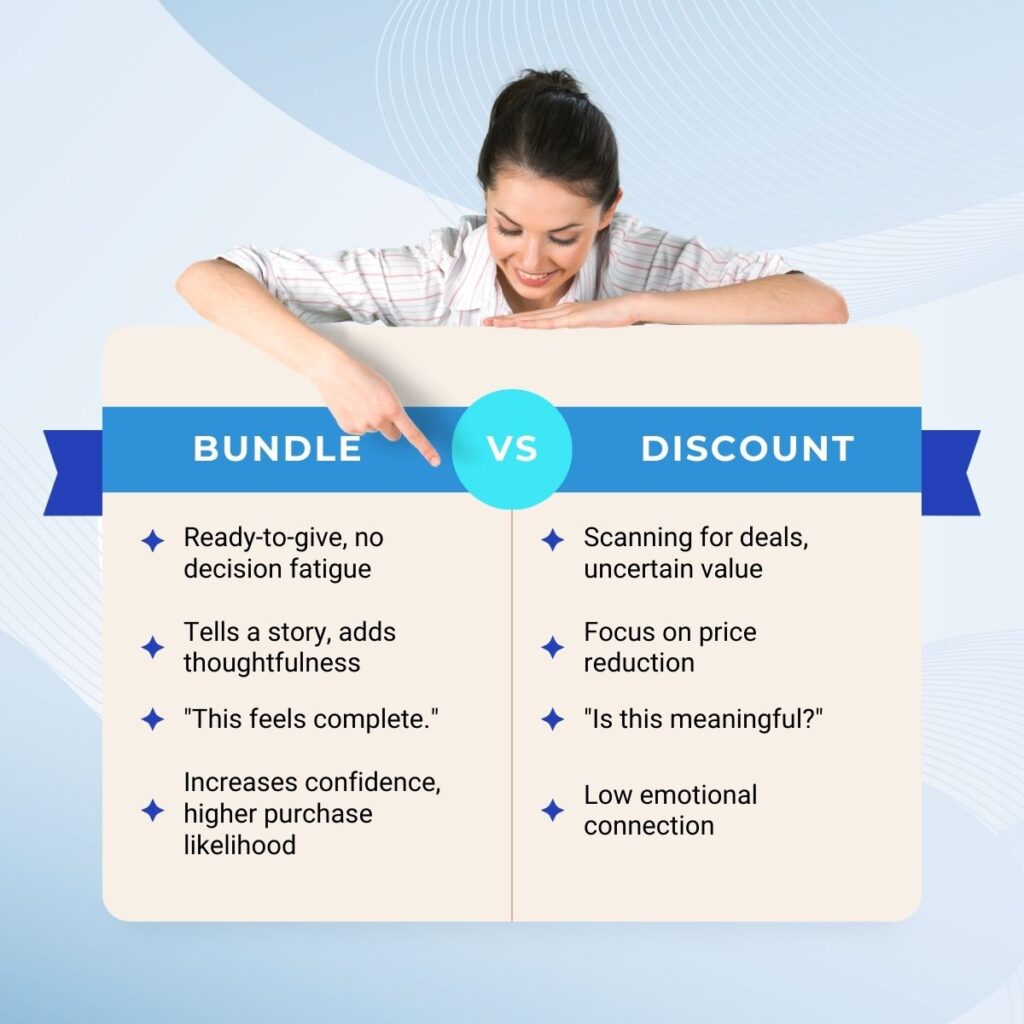
If you think about how your customers shop for Valentine’s Day, most of them aren’t in “deal mode.” They’re under time pressure. They’re worried about getting the gift right. When you show them a discount, they start comparing prices and second-guessing the value of the gift. You’ve probably seen this happen; interest goes up, but hesitation does too.

A bundle creates a very different experience. Instead of asking customers to decide what to add or whether something is missing, you’re handing them a ready-to-give gift. That reassurance matters, especially in the final days before Valentine’s Day. Customers move faster when they feel like the decision has already been made for them.

The messaging also shifts in an important way. A discount talks about saving money. A bundle talks about meaning. Shoppers often react with thoughts like, “This feels complete,” or “I don’t need to think about this anymore.” Those reactions are what push someone from browsing to buying.

From what merchants see in real campaigns, this difference directly affects results. Bundles tend to convert better, reduce hesitation, and lead to repeat purchases because customers remember how easy and confident the buying experience felt.

Bundle vs Discount: Comparison Table

This doesn’t mean discounts are bad. They can support an offer. But when you lead with a bundle, you’re helping customers make a decision they already want to make.

When to Use Discounts and When to Rely on Bundles

If you’re weighing bundle vs discount, the truth is you don’t always have to choose just one. Discounts can still work, especially when they support a bundle instead of replacing it.

Discounts can make sense when:

  • You’re selling low-priced or repeat-use products
  • You want to add a small incentive to an existing bundle
  • Free shipping or a bonus item helps remove the final hesitation

Bundles should lead when:

  • The purchase is gift-driven
  • Customers may feel unsure about what to buy
  • You want the product to feel complete and intentional

A good rule of thumb is to lead with the bundle and use discounts lightly. Think of discounts as support, not the headline. Frame the value around what’s included and why it makes a great gift, rather than how much money is saved.

Some merchants use Shopify 捆绑应用程序 like PushBundle simply to structure these offers more clearly, not to push discounts harder, but to make bundles easier for customers to understand and choose. These apps make your task easier by offering easy set-up of mix and match, volume, cross-sell bundles, etc.

How to Leverage Valentine’s Bundles for Long-Term Growth

Valentine’s bundles don’t just help you sell more in February. When done well, they build trust. Shoppers remember how easy and reassuring the buying experience felt, not just what they paid.

That experience carries forward. Customers who bought a thoughtful bundle are more likely to return for birthdays, anniversaries, or future holidays. You can follow up with similar curated sets or exclusive bundles, turning a one-time gift buyer into a repeat customer.

Over time, this approach helps future-proof your store. Instead of training customers to wait for discounts, you’re teaching them to expect value, care, and convenience. Investing in bundles builds stronger relationships and steadier revenue than relying on discounts alone.

结论

When you step back and look at the bundle vs discount for Valentine’s Day 2026, the pattern is clear. Bundles work because they match how customers actually buy gifts. They reduce uncertainty, feel thoughtful, and help shoppers move forward with confidence, while discounts alone often shift focus back to price.

If Valentine’s Day is an important moment for your store, now is the right time to start planning your bundles. Even simple, well-curated sets can make a big difference. For a deeper breakdown of bundle types, pricing, and execution, you can revisit our main Valentine’s bundle guide or explore PushBundle to build and present bundles more clearly for your customers.

FAQ: Bundle VS Discount

Does a bundle mean a discount?

No. A bundle groups products together to create a complete offer. A discount lowers the price. A bundle can exist without any discount and still feel valuable because of what’s included.

What is the difference between a discount and a bundle?

A discount focuses on price reduction. A bundle focuses on combining products in a way that feels useful or gift-ready. One changes the price, the other changes the experience.

How is bundling different than a discount?

Bundling helps customers decide what to buy by presenting a complete option. Discounts ask customers to make more decisions while thinking about savings.

Are discounted bundle deals a good idea?

They can be, when used carefully. A small incentive like free shipping or a minor price reduction can support a bundle, but the bundle should remain the main value driver.

Should I lead with a bundle or a discount for Valentine’s Day?

Lead with the bundle. If needed, add a small incentive to remove hesitation, but avoid making the discount the headline.

解锁 PushBundle 的全部潜力 – 无风险!

只需单击一下即可开始,并了解更智能的捆绑如何改变您的销售。

zh_CN简体中文