If you sell products that naturally come in multiples, and you’ve tried bundling them with limited results, the problem might not be the bundle itself. It might be that you’re deciding what goes in it.
Personalization changes this thing. It isn’t just a nice experience, it’s a revenue driver. According to 麦肯锡, fast-growing companies generate 40% more of their revenue from personalization than slower-growing ones, and mix and match bundles are one of the more direct ways to put that into practice on a Shopify store.
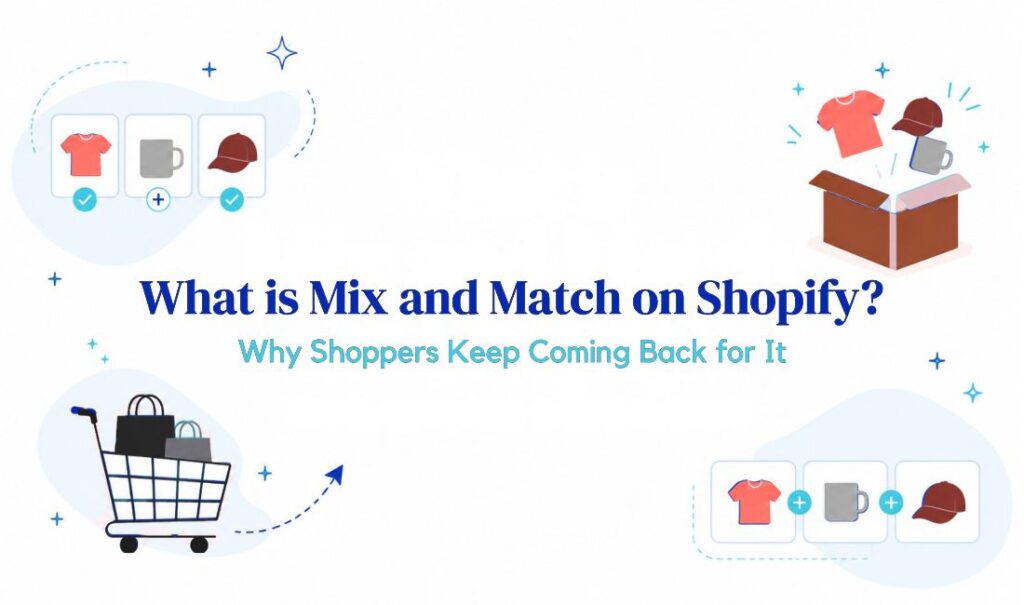
Mix and match on Shopify means letting customers choose different products or variants and combine them into one bundle or set.
You set the frame: pick any 5, choose any 3 from this collection, build a 25lb box. The shopper fills it in. They pick what they actually want, the bundle price or discount kicks in when they’re done, and they check out. That’s the whole concept.
It’s not complicated. But it changes something important about how customers experience your store, and that’s worth understanding before you decide whether it’s right for you.
A mix and match on Shopify lets customers build their own bundle by choosing different products or variants from a selected group. For example:
A merchant sells coffee. Instead of selling a fixed pack like:
The merchant can let customers create their own pack: “Choose any 3 coffee flavors”.
The customer may select:
This is called a mix and match bundle.
A mix and match Shopify bundle has three components.
On the storefront, the shopper sees a grid or a selector. They pick their items. A progress bar or counter tracks how far along they are. The Add to Cart button stays locked until the bundle is complete, so no one checks out with an incomplete selection.
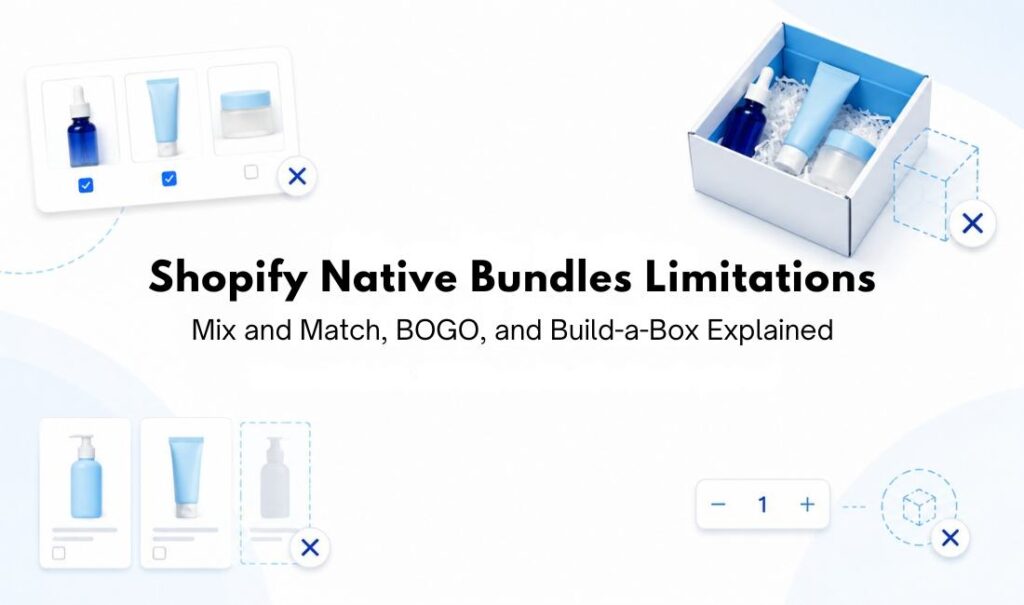
One thing worth knowing: Shopify doesn’t offer this natively. The platform supports fixed bundles and multipacks, but there’s no built-in interface that lets customers select their own combination from a product pool in real time. You need an app to add that selector, enforce the quantity rules, and apply the discount at checkout.
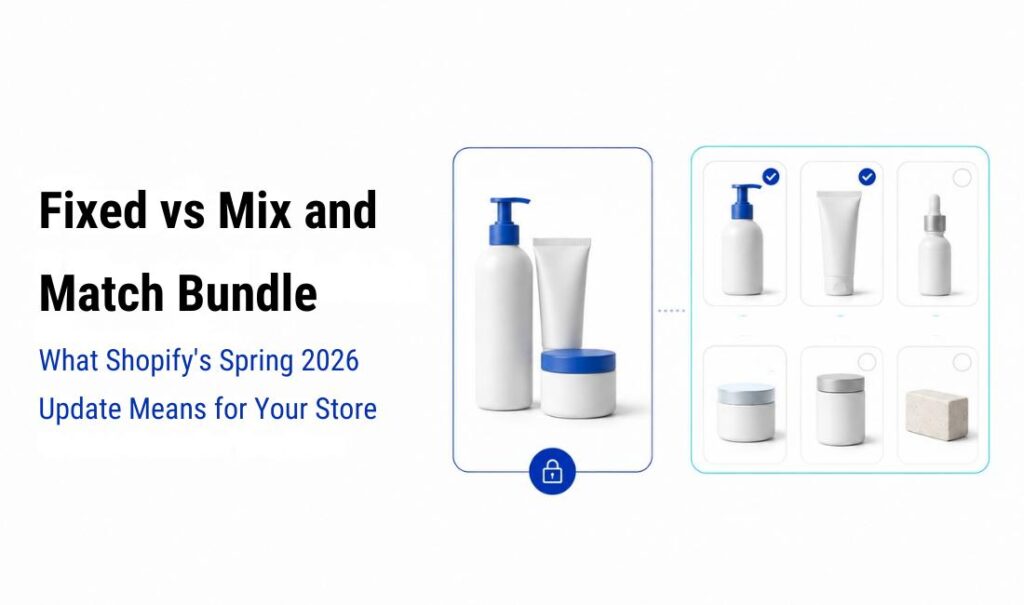
A fixed bundle is exactly what it sounds like. You decide what goes in it, you set the price, and the shopper buys it as-is. A skincare brand might sell a cleanser, toner, and moisturizer together at a slight discount. A coffee shop might package three blends into a sampler set. The merchant does all the choosing. The shopper either wants that specific combination or they don’t.
Mix and match on Shopify works differently. It’s basically “build your own bundle“. The merchant still sets the rules, but the shopper builds the actual bundle. Same skincare brand, different setup: pick any 3 products from the skincare range. Same coffee shop: choose any 4 bags from the full collection.
| 混合搭配 | 固定捆绑 | |
|---|---|---|
| Who builds the bundle | The shopper | The merchant |
| Product selection | Shopper picks from a defined pool | Merchant pre-selects every item |
| Setup complexity | More upfront thought required | Simpler to configure |
| Margin control | Harder to predict exactly | Easier to price and protect |
| Best for | Stores with variety and strong personal preferences | Stores with one logical, universally appealing combination |
| Biggest risk | Shopper abandons if the pool is too small or the choice feels overwhelming | Shopper skips the bundle because of one item they don’t want |
| Gifting use case | Strong; buyer curates for the recipient | Weaker; buyer has to hope the recipient wants the exact set |
| Shopify native support | No; requires an app | Partial; Shopify Bundles supports basic fixed sets |
| Discount trigger | Unlocks when shopper completes their selection | Applied to the pre-built set as listed |
Neither format is better in every situation. Fixed bundles are simpler to run, easier to price accurately, and work well when there’s one logical combination that most customers would want anyway. Mix and match takes more thought to set up but removes the biggest reason shoppers skip fixed bundles, which is covered in the next section.
The choice between them comes down to your product line and your customer. If most people who buy your bundle would choose the same combination anyway, a fixed bundle is fine. If your customers have strong individual preferences, and the “wrong” item in a fixed set is enough to make them walk away, mix and match is worth looking at.
Most explanations of why mix and match works stop at “customers feel more in control.” That’s true, but it’s not the whole picture. There are a few specific things happening that are worth understanding.
The veto problem. One item a shopper doesn’t want in a fixed bundle is often enough to kill the entire purchase. Not because the rest of the bundle isn’t good, but because buying something they don’t need feels like a bad deal even when the math works out in their favor. Mix and match removes that blocker entirely. Every item in the bundle is something they chose.
The ownership effect. When someone builds something themselves, they feel more ownership over it before they’ve even bought it. They spent time on it. They made decisions. That psychological investment makes them more likely to complete the purchase than they would be with something pre-packed.
The reward framing. With a fixed bundle, the discount feels like a sale. With mix and match, the discount feels like a reward for completing something. According to Kivetz, R., Urminsky, O., & Zheng, Y’s research, customers enrolled in loyalty programs accelerate their purchase frequency as they approach rewards thresholds. “You built a 5-pack, here’s 20% off” lands differently than “this bundle is 20% off.” The shopper feels like they earned it rather than stumbled into it.
Gifting. This one is underrated. When someone is buying a gift, a fixed bundle forces them to guess whether the recipient would want all of those specific items. Mix and match lets them curate something that actually fits the person they’re buying for. That’s a meaningfully better experience, and it’s why mix and match performs particularly well in gifting categories.
Mix and match on Shopify isn’t a fit for every store. It works well in specific situations. It tends to perform best when customers have strong personal preferences within a category.
Color and fragrance are the clearest example: what one person loves, another person can’t stand. Letting shoppers choose their own combination isn’t just a nice-to-have, it’s the only way a bundle makes sense.
Food and snacks, for example bakery items, work similarly, especially when dietary preferences or flavor preferences vary widely across your customer base. Apparel accessories, stationery, and beauty products follow the same logic.
Gifting stores are another strong fit. So are stores where the product naturally comes in bulk but the customer always wants a specific mix, think color powder for events, craft supplies, or specialty teas.
Where it works less well: stores with a small product catalogue that doesn’t give shoppers meaningful choices, products where there’s one obvious combination that almost everyone would pick anyway, or categories where the value is in the expert curation rather than the personal selection. A carefully curated gift hamper where “the store picked it” is part of the appeal is a case where a fixed bundle might actually convert better.
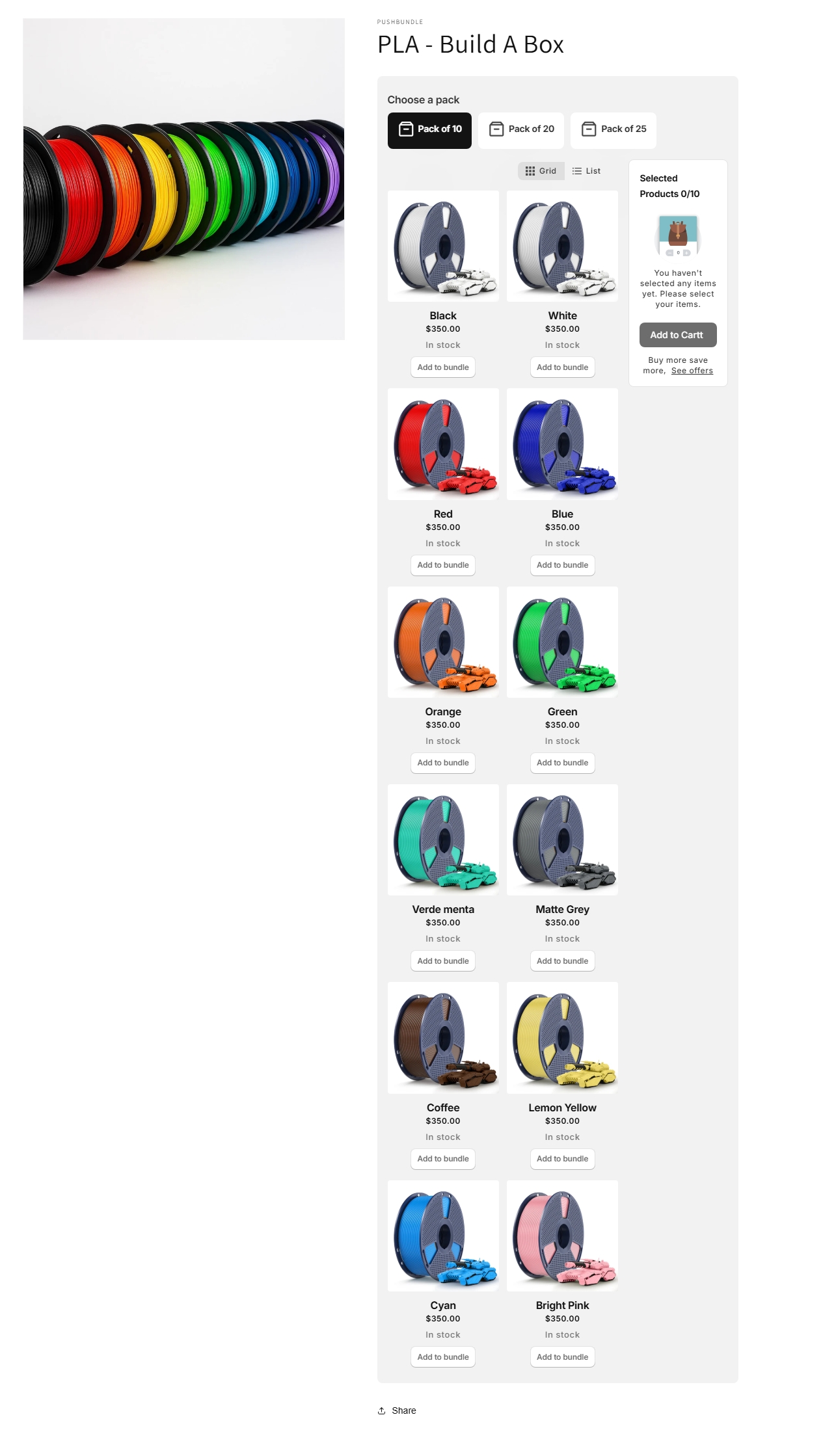
Chameleon Colors sells color powder in 10 shades for events: color runs, gender reveals, school fundraisers, Holi festivals. Their customers almost always want more than one color. But Shopify’s default product page only let them pick one at a time.
That wasn’t a minor inconvenience. It was a structural mismatch between how customers wanted to buy and how the store was set up to sell.
They created two mix and match on Shopify using PushBundle: a 5lb option and a 25lb bulk bundle, each with flexible quantity tiers. The Add to Cart button stays locked until the bundle is complete, so no partial orders reach checkout. Shoppers pick their colors, fill their quantity, and check out in one clean flow.
The result was $21,946.30 in bundle sales across 29 orders, with an average order value of $756.77. That’s not a marketing result; it’s what happens when the buying experience matches the way customers actually want to shop.
A few honest questions worth asking before you set anything up.
Do your customers naturally want more than one item? If someone typically buys just one product from you and moves on, a bundle of any kind is a harder sell. Mix and match works best when multi-item purchases are already part of how your customers think about your products.
Does your product line have enough variety to make the choice meaningful? If you have three products and they’re all fairly similar, there’s not much to mix and match. You need enough options that different customers would genuinely make different selections.
Are you already losing bundle sales because of the fixed set problem? If you’ve tried fixed bundles and the conversion rate is low, it’s worth checking whether customer feedback points to the pre-selected items as the issue. That’s the clearest signal that mix and match would perform better.
If you’re selling in a category where personal preference drives the purchase, and your customers already tend to buy in multiples, mix and match is probably worth testing.
The actual setup is easier than it looks. Here’s the general process, regardless of which app you use.
Decide which products or variants are eligible for the bundle. This can be your entire catalogue, a specific collection, or a hand-picked selection. The narrower and more curated the pool, the easier the decision is for the shopper.
Decide how many items a shopper needs to select to complete the bundle. This can be a fixed number (exactly 5), a minimum (at least 3), or a tiered structure (3 items, 5 items, or 10 items at different price points).
Options typically include a flat bundle price, a percentage discount off the combined total, or tiered discounts that increase as the shopper adds more items. Tiered pricing tends to encourage larger selections without requiring the merchant to set a fixed quantity.

Since Shopify doesn’t offer these types of bundles on its own, you need a third-party mix and match bundle app. There are many apps available in the App Store. You need to understand your requirements to find out the best Shopify mix and match bundle apps for you.
Most apps do this through an app block you place on the product page or a dedicated bundle page. No coding required on most modern Shopify themes.
Go through the shopper experience yourself. Check that the Add to Cart button stays locked until the bundle is complete, that the discount applies correctly at checkout, and that inventory updates properly for each individual item selected.
No. Shopify’s built-in bundle feature supports fixed bundles and multipacks, but it doesn’t let customers select their own combination from a product pool. You need a third-party app to add that functionality.
Yes. Most mix and match apps support percentage discounts, flat bundle prices, and tiered pricing that increases the discount as customers add more items. The discount typically applies automatically at checkout once the bundle is complete.
It depends on how much variety exists within that catalogue. If you have 10 products that are meaningfully different from each other, mix and match can still work well. If you have 5 products that are all fairly similar, there may not be enough choice to make the format worth setting up.
Most mix and match apps handle this by keeping the Add to Cart button disabled until the shopper has met the quantity requirement. Some also add a validation step at cart or checkout. This is worth testing before you go live, since the behavior can vary between apps and themes.
Mix and match on Shopify works because it solves a real problem in how shoppers experience bundles. Not everyone wants the same combination, and forcing them into one is often the reason a bundle doesn’t convert. When shoppers get to choose, the bundle stops feeling like a packaged deal and starts feeling like something they made.
That said, it’s not the right format for every store. If your customers already have strong preferences within your product line, and multi-item purchases feel natural for what you sell, it’s worth testing. If your catalogue is small or your customers expect you to do the curating, a fixed bundle might serve you better.
The setup itself isn’t complicated. Define the pool, set the rules, pick a pricing structure, and let shoppers do the rest.