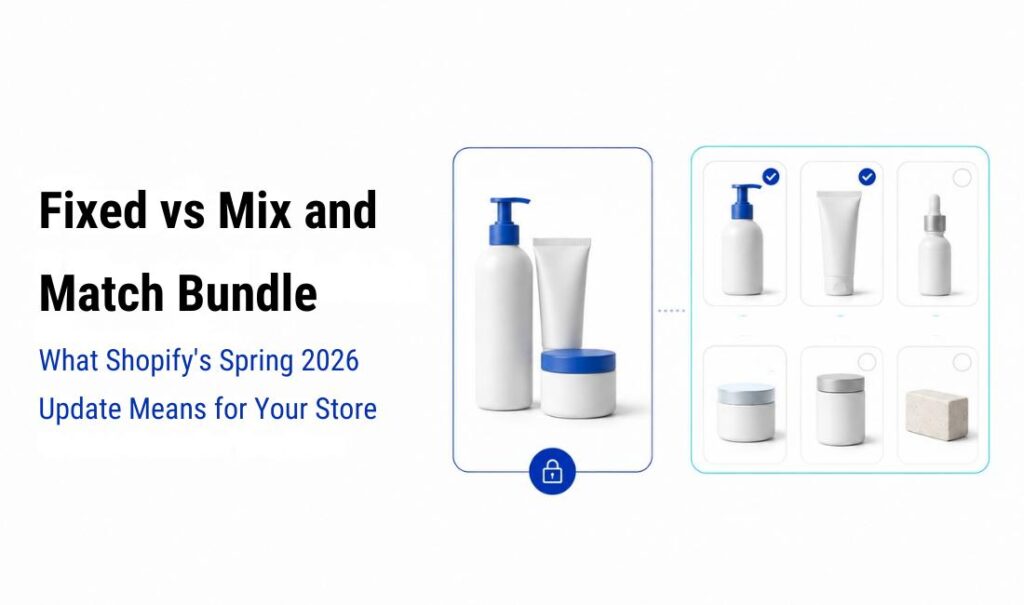
Shopify’s Spring 2026 update just gave fixed bundles a real advantage. You can now show them in Google search, Google ads, and YouTube, so more shoppers can find your bundle before they even land on your site.
Pacchetti mix and match didn’t get that boost, but they still do something fixed bundles can’t. They let the customer build exactly what they want.
Now, if you’re hoping one of these two formats wins outright in the fixed vs mix and match bundle debate, that’s not how this actually plays out. Neither is better than the other. This Shopify spring 2026 bundle update comes down to whether your store benefits more from being found through a search channel, or from giving customers control over what’s inside the box.
- Shopify’s Spring 2026 update lets fixed bundles show up in Google search, Google ads, and YouTube, something mix and match bundles still can’t do.
- Facebook and Instagram bundle eligibility is mentioned on Shopify’s editions page, but not yet confirmed in the Help Center, so treat that part as still developing.
- Mix and match bundles still win on personalization and average order value, especially for stores selling interchangeable products like teas, cosmetics, or snacks.
- The right bundle type depends on whether your store depends more on channel discovery or on-site customer choice.
- PushBundle supports build-a-box and mix & match bundles alongside fixed bundles, so you’re not locked into one format as your strategy shifts.
Sommario
What Actually Changed for Fixed Bundles in Shopify’s Spring 2026 Update
Before this update, a fixed bundle you built in Shopify worked the same way it always had. Customers found it by browsing your store, not by searching for it on Google.
IL Shopify’s Spring 2026 edition lists fixed bundles as newly eligible to appear in Google search, Google ads, and YouTube. This is undoubtedly a real distribution win. Now shoppers searching for a product on Google could see your bundle listing before they ever click through to your store.
Shopify’s Help Center backs up the Google and YouTube part of this directly, confirming bundles can be sold through the Google & YouTube sales channel using fixed product bundles only. Mix and match bundles aren’t part of that eligibility, at least not yet.
Shopify’s Spring ’26 Editions page says fixed bundles can be published across Google, YouTube, Facebook, and Instagram, but the linked Help Center documentation currently only confirms fixed bundle support for Google & YouTube, not Meta. Editions pages often describe features rolling out in stages. If you’re planning to sell Shopify bundles on Facebook and Instagram as part of your marketing, keep an eye on Shopify’s Help Center for confirmation before building a whole campaign around it.
Fixed vs Mix and Match Bundles: The Actual Difference
Before we get into which one fits your store, it helps to be clear on what each type actually does.
- Fixed bundles: You decide exactly what’s inside. The customer buys the whole set as you built it, with no substitutions.
- Pacchetti mix and match: The customer picks from a set of products you define, building their own combination within the rules you set.
- Multipack bundles: A specific case of fixed bundles where the “bundle” is just multiple units of the same product.
- Channel eligibility: Fixed bundles can now appear in Google search, Google ads, and YouTube. Mix and match bundles can’t, at least not through this update.
- Native app support limitation: Shopify’s free Bundles app handles fixed and multipack bundles, but it doesn’t support mix and match bundles at all, so you’ll need a third-party bundle app like PushBundle, or a custom build through Shopify Plus, if you want that experience.
Why the Channel Update Matters More for Some Stores Than Others
This update does not make fixed bundles better than mix and match bundles. It simply gives fixed bundles a channel advantage that mix and match bundles cannot structurally have.
Fixed bundles now have a distribution option mix and match structurally can’t get. Since a mix and match bundle doesn’t have one set combination for Google or YouTube to index and show. There’s no single product to feature because the combination changes with every customer who builds one.
For a store that depends heavily on Google Shopping traffic or YouTube product listings to acquire new customers, this is a genuine reason to lean into fixed bundles now. A skincare brand selling a “Starter Set” bundle, for example, can get that exact set discovered by someone searching for a skincare routine, without needing them to already know the store exists.
But if your store’s bundle strategy depends on customers browsing your site and building their own combination, like a tea shop letting people pick any five flavors, this update doesn’t change much for you. That kind of bundle was never going to be found through a search listing anyway, since it doesn’t exist as one fixed product until the customer builds it. The advantage here is entirely about acquisition, not about which bundle format performs better once someone’s already on your site.
What Mix and Match Bundles Still Do Better
Even with the Spring 2026 update in play, mix and match bundles aren’t losing their reason to exist. They’re just competing on a different strength.
Personalization drives a different kind of purchase decision. When a customer builds their own bundle, they feel like they’re getting exactly what they want instead of settling for someone else’s idea of a good combination. That matters a lot for categories like teas, supplements, cosmetics, and snack boxes, where personal preference is the whole point of the purchase.
Average order value tends to climb when customers are given more choice, not less. A customer picking three items from a curated collection is making three small decisions in a row, and each one is a chance to add another product to the cart.
One thing worth flagging if you’re running mix and match bundles: watch how your bundle rules interact with items that are already on sale. If your offer is something like “pick any 3 from this collection, get 20% off” and that collection includes discounted products, customers can stack the bundle discount on top of an already-reduced price. It’s an easy mistake to make and an easy one to fix. Just exclude sale items from the bundle’s selection pool, or set a rule that blocks the bundle discount from applying to anything already marked down.
And if you’re wondering whether this update affects your ability to sell Shopify bundles on Facebook and Instagram through a mix and match format, it doesn’t, at least not based on what’s documented so far. Mix and match bundles simply aren’t part of that channel eligibility conversation right now.
How to Decide Between Fixed and Mix and Match for Your Store
Here’s a practical way to think through it, instead of picking based on which one feels more modern.
Check where your customers actually find you. If a meaningful chunk of your traffic comes from Google Shopping, Google ads, or YouTube, fixed bundles now have a direct path to reach those shoppers before they land on your site. Testing Shopify bundles on Google Shopping is worth doing even if your acquisition strategy has always leaned on-site.
Look at whether your catalog is genuinely interchangeable. If your products are different flavors, colors, or scents of a similar item, mix and match still makes more sense on-site, since customers are choosing based on personal taste rather than needing your curation.
Run both formats instead of picking only one. A lot of stores use a couple of fixed bundles built specifically to catch search traffic, alongside a mix and match builder for the customers already browsing the site. That’s part of why apps like PushBundle support build-a-box and mix & match bundles side by side with fixed bundles, so you’re not stuck rebuilding your entire bundle setup every time your acquisition strategy shifts. It’s not about needing one app to do everything perfectly, it’s about not being locked into one bundle format when your traffic sources or catalog change.
Start small if you’re still not sure. Set up one fixed bundle around your best-selling combination and give it a few weeks to see if it picks up any Google Shopping or YouTube traffic. Keep your existing mix and match offer running in parallel and compare how each one actually performs before committing more budget or design time to either format.
Fixed vs Mix and Match Bundle: The Bottom Line
If you’re weighing fixed vs mix and match bundle formats for your Shopify store, the split comes down to this. Fixed bundles now have a real shot at outside distribution through Google Shopping, Google ads, and YouTube, which makes them a smart pick if a good chunk of your customers come from search. Mix and match bundles still make more sense for interchangeable product lines where the customer’s choice, not your curation, is what makes the offer worth buying. Most stores don’t need to pick a side permanently. They need whichever format matches the SKU and channel behind it, and the Shopify Spring 2026 bundle update just gave you one more good reason to run both.
Fixed vs Mix and Match Bundle: FAQ
Can Shopify’s native Bundles app create mix and match bundles?
No. Shopify’s free Bundles app only supports fixed and multipack bundles. For mix and match, you’ll need a third-party app or a custom build through Shopify Plus.
Can Shopify bundles be sold on Facebook and Instagram?
Shopify’s Spring 2026 editions page lists Facebook and Instagram as new channels for fixed bundles, but the Help Center currently only confirms Google search, ads, and YouTube. Treat Facebook and Instagram eligibility as still developing until it’s directly documented.
What’s the most common mistake merchants make with mix and match bundle discounts?
Letting the bundle discount stack on top of products that are already on sale. This usually happens when the selection pool includes discounted items without an exclusion rule in place.
Does bundle inventory sync automatically when a bundle sells?
Yes. Shopify updates each component’s inventory in real time when a bundle sells, and the product with the lowest stock level determines how many bundles are available.

Syeda Rehnoma Tanzom
This article was reviewed by the PushBundle Technical Support Team, who regularly helps Shopify merchants test bundle setup, product selection rules, bundle pricing, cart behavior, and checkout-related bundle issues.

Blog in evidenza post
Luglio 9, 2026
Fixed vs Mix and Match Bundle: What Shopify’s Spring 2026 Update Means for Your Store

30 giugno 2026
PushBundle contro Bundler: quale app per la gestione di bundle su Shopify vale la pena nel 2026?
29 giugno 2026

 Italiano
  English
  日本語
日本語  Français
  Deutsch
  Español
  简体中文
简体中文